A machine learning workflow organizes the path from data to predictions. It extends a data pipeline with processing, feature creation, feature selection, model training, evaluation, deployment, and ongoing monitoring. The goal is an automated, repeatable, and hardened process rather than a collection of scattered notebooks. section 1.4 section 1.4.6
A practical workflow commonly includes these steps:
- Ingest the required data from source systems. section 1.4 section 9.2
- Clean the data and engineer useful features. section 1.4 section 1.4.6
- Select features, train a model, and generate evaluation metrics. section 1.4 section 1.4.6
- Serve or store predictions, then monitor performance and feature distributions. section 1.4.6 section 9.2
Customer churn prediction
A focused pipeline ingests customer churn data, trains a gradient boosting model on training data, predicts outcomes for a separate test dataset, and writes those predictions to a database table. A more complete workflow can then add rigorous tests and automatic scheduling. section 9.2
Pipeline structure also improves maintainability. Separate scripts such as 1_fetch_dataset.py, 2_clean_dataset.py, 3_feature_engineering.py, 4_feature_selection.py, 5_train_model.py, and 6_generate_evaluation_metrics.py make responsibilities visible and support collaboration. Production use additionally requires source control, scaling, readable structure, and exception handling. section 1.4.6 section 1.5
Figure 1.7 A sample workflow of a machine learning pipeline extending from a data pipeline. This diagram shows an outline of a typical machine learning pipeline. Keep in mind that the starting point is data. Data is always needed for any machine learning pipeline. The final part is monitoring the model to validate its performance on an ongoing basis. These and the in-between components are detailed in the following subsections.
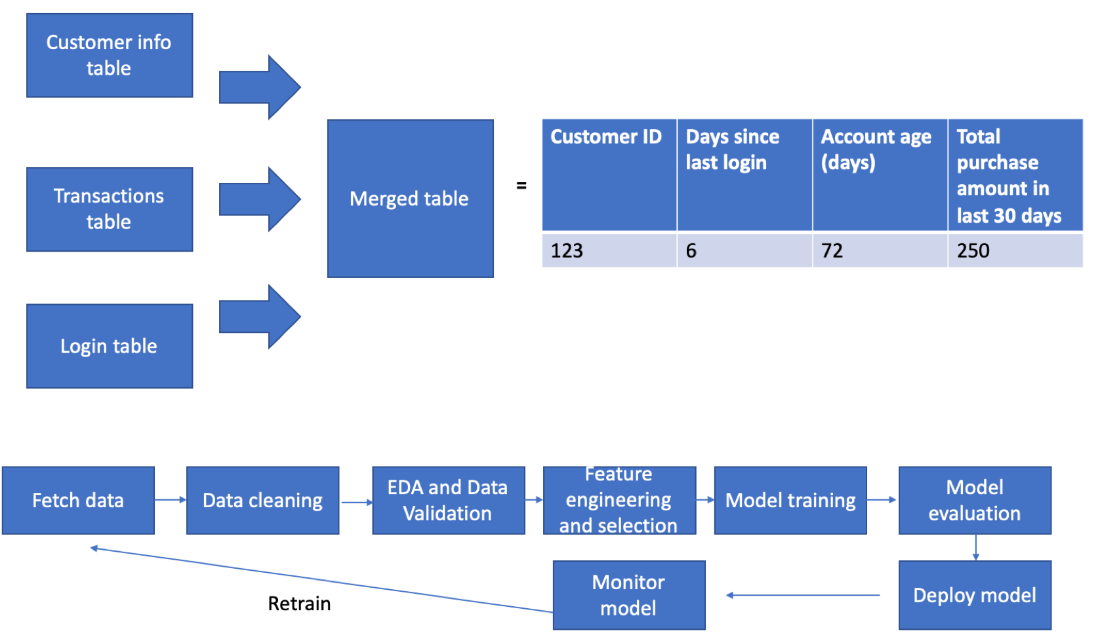
Use the workflow diagram to follow the pipeline from required input data through intermediate processing and modeling steps to ongoing model monitoring. section 1.4








