The predictive threat index (PTI) estimates the likelihood of future cybersecurity incidents using past attacks, threat intelligence, and current monitoring. Its purpose is to help security teams prioritize likely attack vectors, allocate resources, and prepare a response. Unlike the risk exposure index (REI), which describes overall current risk, PTI looks ahead. section 10.2 section 10.2.2
A practical PTI assessment brings together:
- Historical incidents, to identify attacks that may recur. section 10.2.2
- Threat intelligence, to track observed and emerging attack patterns. section 10.2.2
- Current vulnerabilities and monitoring, to update the assessment as conditions change. section 10.2.2 section 10.2
A basic malware estimate
A simple PTI calculation is incidents × threat likelihood ÷ total assets. With 15 malware attacks in a year, a 30% threat likelihood, and 200 critical assets, the result is 15 × 0.30 ÷ 200 = 0.0225, presented as 2.25%. This gives the security team a figure for prioritization. Treat the simple calculation as an estimate tied to its inputs, rather than a reason to ignore other risks. section 10.2.2
Figure 10.1 The left side shows risk exposure and predictive analytics before implementing improvements. The right side shows the situation afterward.
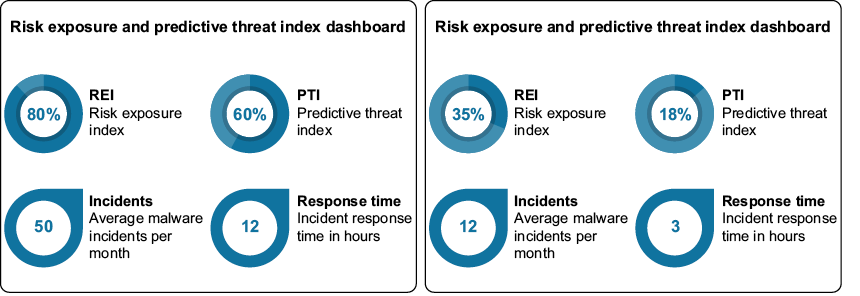
Compare the before-and-after dashboard with explicit targets. The initial PTI indicates a 60% likelihood of a malware attack in the next six months; the target is below 20%. Review PTI alongside risk exposure, incident frequency, and response time rather than as a standalone verdict. section 10.2.3
To put PTI to work, collect incident and threat data, inspect patterns, and present the forecast in a dashboard. Elastic Stack supports data collection, analysis, and visualization; Wazuh supports real-time monitoring and predictive models. Use the resulting estimate to decide where to strengthen defenses, then revisit it as new information arrives. section 10.2.5 section 10.2.2
