Predictive analytics
Predictive analytics is the use of data and statistical or computational methods to estimate future or otherwise unknown outcomes.

The Art of AI Product Development
The analysis of data with statistical or machine-learning methods to estimate future or unknown outcomes.
- How it is used
- Supports data-driven product and operational decisions with predictions, classification, and pattern recognition.
- How deep it goes
- Defines predictive AI and its common tasks, with an example of choosing a simpler model over a generative one.
- Examples
- Uses movie-review sentiment analysis and personalized fashion recommendations to illustrate predictive applications.
- What you can do after
- Evaluate predictive AI for defined product problems against alternatives using accuracy, cost, and privacy considerations.
Read how The Art of AI Product Development explains predictive analytics →
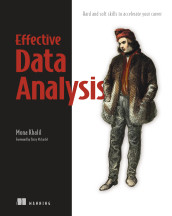
Effective Data Analysis
Predictive modeling is the construction and use of models to generate predictions for new or unknown observations.
- How it is used
- Supports stakeholder decisions by estimating outcomes for new observations from historical data.
- How deep it goes
- Outlines question setting, predictor investigation, model fitting, testing, diagnostics, and deliverable design.
- Examples
- Uses house-price regression and exercises on predicting product profit margins.
- What you can do after
- Apply predictive modeling via statsmodels to fit a housing regression and consider its suitability for new cases.
Read how Effective Data Analysis explains predictive analytics →

Data-Driven Cybersecurity
Predictive modeling is the construction of statistical or computational models that estimate likely future or unknown outcomes from data.
- How it is used
- Supports proactive cybersecurity decisions by forecasting incidents and directing attention toward likely threats.
- How deep it goes
- Defines the approach and works through risk metrics and a dashboard exercise, but defers a deep dive into statistics and AI.
- Examples
- Uses a financial-services dashboard with malware likelihood, incident volume, response time, and before-and-after risk scores.
- What you can do after
- Apply it via risk and threat indexes to set targets, prioritize defenses, and assess measured improvement.
Read how Data-Driven Cybersecurity explains predictive analytics →
Also covered in
- Acing the CCNA Exam: Volume 2 Advanced Networking and Security
- Data for All
- Grokking Statistics
- The Complete Obsolete Guide to Generative AI
- Demand Forecasting Best Practices
- Digital Twins in Action
- Cyber Threat Hunting
- Data Without Labels
- Architecting an Apache Iceberg Lakehouse
What to know first
- language modelA language model is a computational model that represents patterns in linguistic sequences to assign probabilities, predict, generate, or evaluate language.
- advanced analyticsAdvanced analytics is the application of sophisticated statistical, computational, or machine-learning methods to derive insights, discover patterns, generate predictions, or support decisions from data.
- machine learningMachine learning is a field of computational methods in which systems learn patterns or relationships from data to make predictions, decisions, or other outputs.
- PythonPython is a high-level, general-purpose, dynamically typed programming language with readable syntax and support for multiple programming paradigms.
Related concepts
- labeled datauses · Labeled data is a collection of examples paired with target values, categories, or other task-relevant annotations.
- linear regressionuses · Linear regression is a statistical method that models a numeric response as a linear function of one or more predictor variables with fitted parameters.
- conversational aikind of · Conversational AI is artificial intelligence that enables software systems to interpret user input and interact with users through natural-language dialogue.
- data analysiskind of · Data analysis is the systematic examination, transformation, and interpretation of data to derive information, identify patterns, or support conclusions and decisions.
- generative modelingcontrasts with · Generative modeling is a machine-learning approach that learns patterns or a data distribution to generate new samples resembling the data.
- historical datauses · Historical data is recorded information about past events, observations, states, or outcomes retained for later access or analysis.
Questions about predictive analytics
What is predictive analytics?
Predictive analytics is the use of data and statistical or computational methods to estimate future or otherwise unknown outcomes.
Which Manning books explain predictive analytics?
The Art of AI Product Development, Effective Data Analysis and Data-Driven Cybersecurity.
What should I know before learning predictive analytics?
Manning books that teach predictive analytics usually introduce language model, advanced analytics, machine learning and Python first.
What is the difference between predictive analytics and generative modeling?
Predictive analytics is the use of data and statistical or computational methods to estimate future or otherwise unknown outcomes. Generative modeling is a machine-learning approach that learns patterns or a data distribution to generate new samples resembling the data.
What is predictive analytics a kind of?
Predictive analytics is a kind of conversational ai. Conversational AI is artificial intelligence that enables software systems to interpret user input and interact with users through natural-language dialogue.
What is predictive analytics also called?
Predictive analytics is also called predictive modeling.
These guides are generated from the text of Manning books by Manning's knowledge graph and link to the sections they draw on. The full books are available on liveBook and at manning.com.