Max pooling downsamples local activation regions by retaining their largest values. In a convolutional neural network, it summarizes feature maps after convolution, reducing noisy and oversized outputs before later layers process them. section 7.1
A practical Keras configuration uses pooling to progressively shrink spatial dimensions:
- Apply MaxPooling2D((2, 2)) after convolutional layers. section 7.1
- Use padding="same" when preserving compatible boundary behavior matters. section 7.1
- Inspect model.summary() to verify the resulting feature-map shapes and parameter counts. section 7.1
Progressive spatial reduction
A CNN can move from 28×28×64 after its first convolution to 14×14×64 after max pooling, then to 7×7×32 and 2×2×16 through successive pooling layers. In an autoencoder, MaxPool layers are added to the encoder to create the funnel or reduction architecture, while UpSampling layers mirror that reduction in the decoder. section 7.1 section 8.2.1
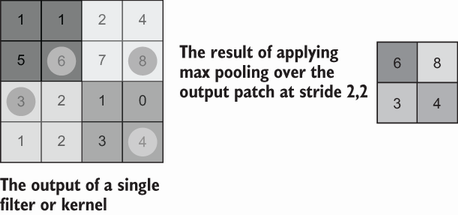
Shows how maximum pooling reduces the output produced by a convolutional operation. section 7.1









