Max pooling is a downsampling operation that retains the largest value within each local window of a feature sequence or feature map. Pooling aggregates information while reducing spatial or temporal dimensions. section 10.2
In a convolutional network, max pooling commonly follows convolution and ReLU activation. Repeated blocks learn increasingly rich features while max pooling reduces feature-map dimensions before later processing. section 10.2.1 section 10.6
The operation appears in several processing settings:
- Use 2D max pooling to reduce image feature maps in a LeNet-style MNIST classifier. section 10.2.1
- Use 1D max pooling after convolutions to process encoded question sequences in a multi-input similarity model. section 10.3.2
- Distinguish maximum aggregation from average pooling and global average pooling, which use different reduction rules. section 10.2
LeNet-style MNIST classifier
A Keras/TensorFlow CNN stacks convolutional, ReLU, and max-pooling operations, then flattens the resulting feature map and applies a dense softmax classifier. section 10.2.1
Figure 10.4 LeNet architecture for MNIST digits classification
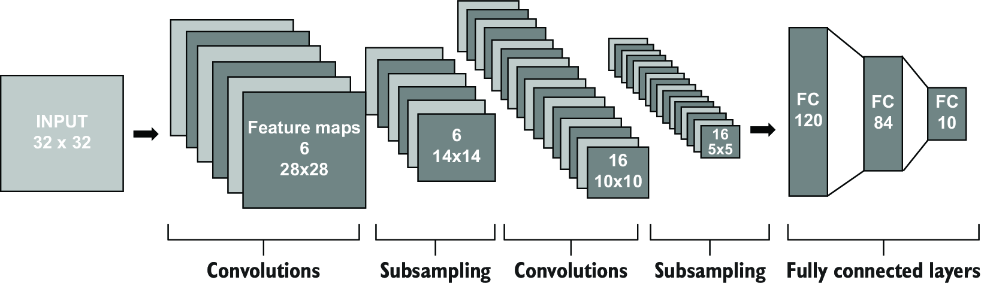
Use the LeNet architecture diagram to trace how max pooling reduces feature-map dimensions between convolutional stages. section 10.2.1









