Max pooling downsamples a feature map by keeping the strongest activation in each local spatial window. In AlexNet, this reduces computation and makes representations more robust to small positional changes and input distortions. section 2.5.1
AlexNet
AlexNet uses 3 × 3 max-pooling windows with stride 2 after its initial convolutional downsampling, reducing spatial dimensions further. section 2.5.1
Figure 2.3 The AlexNet architecture (cropped in the original paper). The numbers indicate spatial dimensions and channel depth at each stage. The input image (224 × 224 × 3 RGB) passes through a series of convolutional and pooling layers that progressively reduce spatial resolution (224→55→27→13) while increasing channel depth. Early downsampling is driven by the first convolutional layer (11 × 11 filters with a stride of 4), followed by max pooling layers (3 × 3 windows with a stride of 2) that further reduce spatial dimensions. The stride determines how far a filter moves across the input at each step, controlling how densely the image is sampled and how quickly spatial resolution is reduced. Filter sizes (11, 5, 3) are depicted as cubes and define the local receptive field of each convolution. The two horizontal streams reflect the model’s original two-GPU training setup, where feature maps were split across devices (e.g., 48 + 48 = 96 channels). The fully connected layers (4096 neurons, implemented as 2048 + 2048 across GPUs) feed into a 1000-way output for ImageNet classification. Used with permission granted by the lead author (Alex Krizhevsky).
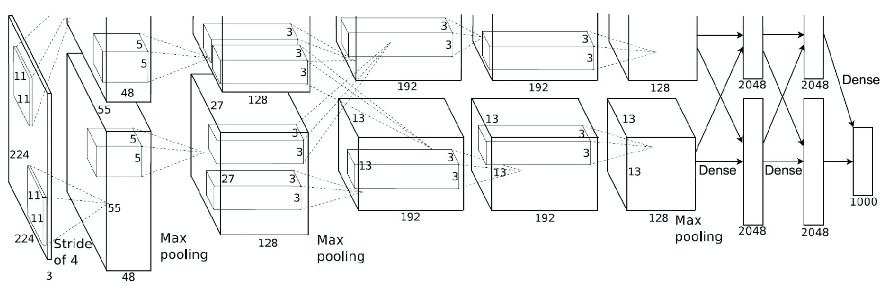
Trace how pooling layers reduce spatial resolution through AlexNet’s architecture. section 2.5.1









