liveBook · Manning

Mean absolute error

As explained in Grokking Machine Learning

A regression error metric equal to the average absolute difference between observed and predicted target values.

Mean absolute error (MAE) measures how far predictions are from observed values on average. For a line fitted to points, it is the average of the absolute vertical distances from the points to the line. section 3.4

Averages make errors easier to compare across datasets of different sizes: a sum can grow simply because one dataset contains more points. Mean square error also averages errors, but squares the distances instead. section 3.4

Figure 3.18 The absolute error is the sum of the vertical distances from the points to the line. Note that the absolute error is large for the bad model on the left and small for the good model on the right.
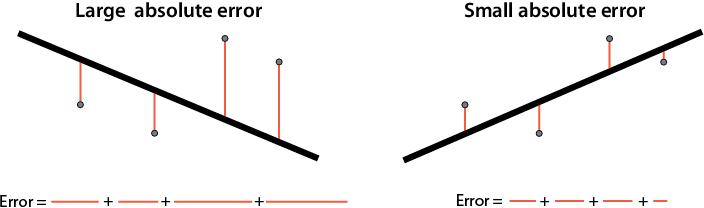
See how absolute vertical distances distinguish a poor-fitting line from a better-fitting one; MAE averages those distances. section 3.4


How Grokking Machine Learning covers it

How deep it goes
Defines MAE as an average of absolute distances and explains why averages support comparisons across dataset sizes.
Examples
Uses vertical distances from points to a fitted line and contrasts datasets containing 10 and 1 million points.
What it assumes
Assumes observed points and a fitted line, with errors represented as vertical distances between them.
What you can do after
Evaluate regression predictions by interpreting average absolute distances and comparing errors across differently sized datasets.
How it connects
Connects absolute error with mean square error and root mean square error as ways to measure regression error.

Also explained in

Compare how 10 books explain mean absolute error →

Related concepts

This explainer was generated by Manning's knowledge graph from the text of Grokking Machine Learning. The section links point to the parts of the book it draws on.







