liveBook · Manning

Mean squared error

As explained in Natural Language Processing in Action, Second Edition

Mean squared error is the average of the squared differences between predicted and target numerical values.

Mean squared error (MSE) measures the average squared difference between predictions and target numerical values. During neural-network training, it turns errors across a batch or training set into one cost that the optimizer tries to minimize. section 5.3

MSE is useful for understanding training because it connects several practical ideas:

  • A lower position on the error surface represents weights that produce smaller average errors across the training data. section 5.3
  • MSE suits regression problems, whereas binary classification more commonly uses binary cross-entropy. section 5.2.5
  • The training objective aggregates errors across examples rather than minimizing the error of only one example. section 5.3

Reading the error surface

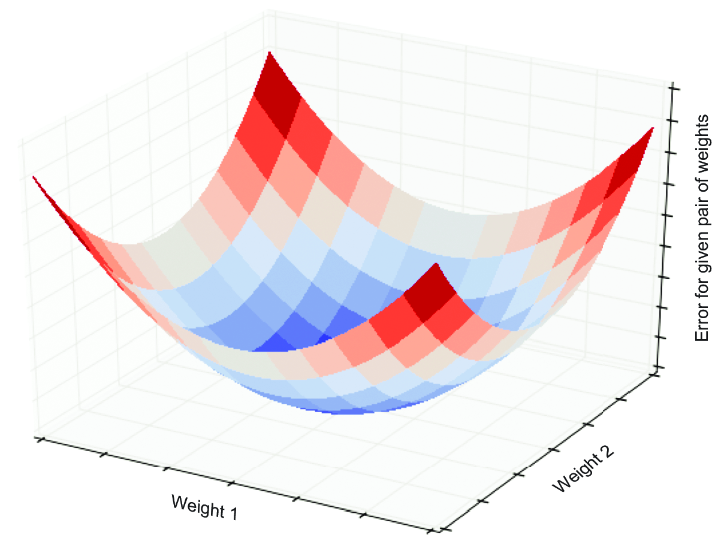
Imagine plotting possible weight values horizontally and MSE vertically. The lowest point is the weight configuration with the smallest average prediction error for the training set; gradient-based optimization moves toward that region. section 5.3

Figure 5.6 Convex error curve
figure

Use the convex error-curve figure to visualize how changing weights changes the aggregate error and where the minimum lies. section 5.3


How Natural Language Processing in Action, Second Edition covers it

How deep it goes
Explains MSE through aggregate error, weight-space minima, and error surfaces, but does not provide its implementation.
Examples
Uses a convex error curve, a three-dimensional weight-and-error bowl, and aggregate errors across training data.
What it assumes
Assumes familiarity with predictions, targets, weights, loss functions, and optimization while developing the error-surface intuition incrementally.
What you can do after
Evaluate/understand how average prediction error guides weight selection and why regression and classification use different metrics.
How it connects
Connects MSE with loss functions, regression, neural networks, weights, optimization, batches, and error surfaces.

Also explained in

Compare how 13 books explain mean squared error →

Related concepts

This explainer was generated by Manning's knowledge graph from the text of Natural Language Processing in Action, Second Edition. The section links point to the parts of the book it draws on.










