A mental model is an internal representation of a target system: a set of perceived facts used for comprehension, communication, and reasoning. A strong model is correct, containing no falsehoods, and complete enough to include every fact relevant to the question being asked. section 1.1.1 section 1.1.2 section 1.1.3
Build and use a mental model by keeping these distinctions clear:
- Separate the system’s ground-truth facts from the model’s perceived facts. section 1.1.1
- Choose facts according to the problem: a model sufficient for calculating current may omit facts needed to explain brightness. section 1.1.3
- Use multiple models when one perspective hides important behavior; different models can be valid when they describe different aspects. section 1.3 section 1.3.2
- Prefer concise models above implementation details when code obscures interactions, concurrency, or system-wide behavior. section 1.8
The circuit and the shared score
An electric-circuit model can represent resistance accurately for one calculation while remaining incomplete for another. Likewise, engineers may hold different interpretations of the same technology term; communication improves as their models overlap with reality and with one another. Analogies can help, but their boundaries must be checked so that similarities do not become false assumptions. section 1.1.3 section 12.6 section 1.2
Figure 1.1 Mental model and system
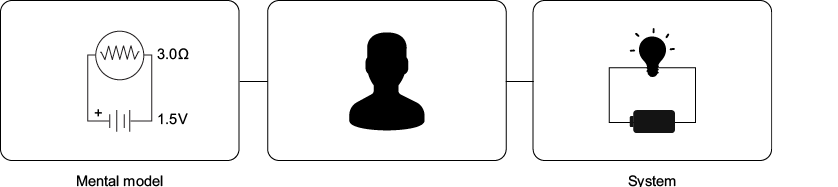
Use the figure to compare the target system with its internal representation and see how a model stands in for system facts. section 1.1.1
The practical test is predictive confidence: a useful model lets you reason about behavior without probing the system blindly. In distributed systems, this means choosing abstractions that expose component interactions, assumptions, and guarantees rather than isolated code. section 1.1 section 1.9





