Middleware is the base software that turns independent networked devices into a system that developers can use through one collection-level API. It manages resources and hides device-level details, much as an operating system exposes files instead of disk sectors. Without it, applications must administer and coordinate each machine separately; with it, they can be deployed and operated without depending on how many devices sit behind the interface. section 4.2
In robotics, middleware supplies communication, composition, resource distribution, deployment, and analysis services. This lets sensing, planning, and acting components run on separate compute devices or move onto one device without requiring an application-level redesign. Deployment flexibility is valuable, but networked components still require attention to the fallacies of distributed computing and, where needed, real-time fieldbus or industrial-network communication. section 4.8
Figure 4.2 Middleware distinguishes a distributed system from a mere collection of computational devices by managing network resources and providing a unified collection-level API for application developers.
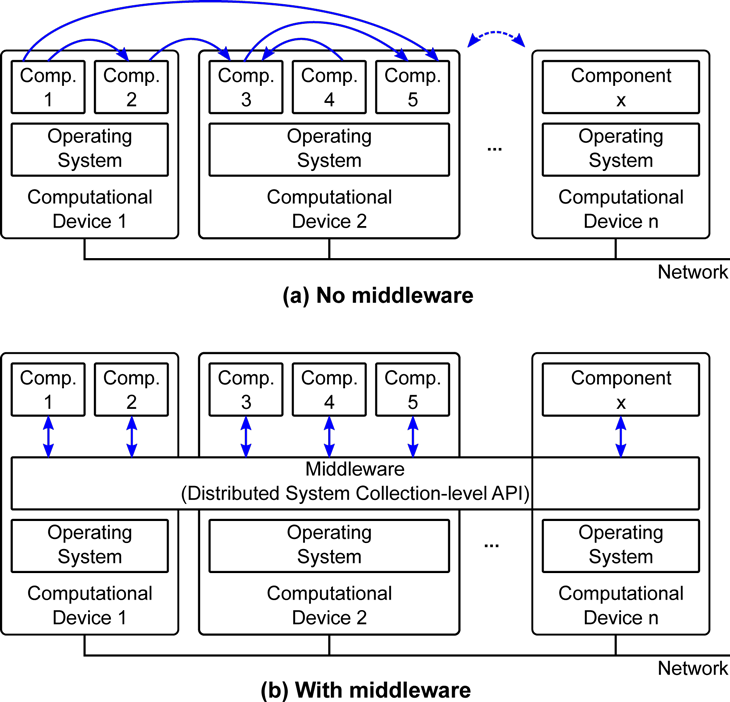
The figure contrasts a collection of machines with a distributed system: middleware is the layer that manages network resources and gives developers a unified interface. section 4.2
A common middleware communication model is publish-subscribe:
- Publishers send a particular message type to a named topic rather than directly to a machine or receiver. section 4.2
- Subscribers register callbacks for that topic and receive its messages without knowing publishers’ network locations. section 4.2
- A topic can connect multiple publishers and subscribers, allowing components to remain decoupled while exchanging specific data. section 4.2
Sharing detected objects
An image-processing component can publish an ObjectList message on a detected_objects topic after packaging each object’s identifier and world pose. Another component subscribes to the same topic with a callback that receives the list and can react to the camera’s detections. Neither component needs the other’s network address. section 4.2
ROS is a widely used open-source robotics framework built around this role: it combines middleware plumbing with tools for data recording, introspection, visualization, and simulation, plus interoperable sensing, planning, and acting capabilities. ROS client libraries expose an API to its middleware; rclpy is the Python client library, while workspaces and colcon support work across packages. section 4.8












