A minimum viable product (MVP) is not the first thing a team can demo. It is the least-developed product that real customers can use, give useful feedback on, and pay for. The point is to test whether a focused solution addresses a valuable problem before time and money disappear into features nobody needs. section 14.1 section 14.0
Think of it as a practical bargain: deliver enough value for early adopters, learn what is actually needed, and leave plenty of future capability for later. “Minimal” does not mean unusable; it means tightly scoped around the customer problem worth solving now. section 14.1 section 14.1.2
Build toward an MVP in a short customer-driven loop:
- Identify a market with a big problem, then find a lighthouse customer when possible. section 14.1
- Choose the smallest feature set that solves that customer’s problem well enough to merit payment. section 14.0 section 14.1
- Show the candidate product to early adopters, collect feedback and requirements, add only the capabilities that matter, and return with the result. section 14.1
- Treat a substantially changed result as normal: the eventual MVP may differ sharply from the initial vision. section 14.1
Do not confuse an MVP with a prototype. A prototype proves to the development team that technologies work together; it may have no polished interface and may never leave the lab. A candidate MVP builds on that work but must be usable by early adopters and refined until it delivers real value and initial sales. section 14.1.1
A deliberately narrow security product
A semiconductor customer helped define a product MVP around three rules, simple processors, and one simple operating system. Support for more processors, additional rule sets, and more complex operating systems went onto the roadmap. The lesson is uncomfortable but useful: saying no to plausible features can be what makes a sellable first product possible. section 14.1.2
Figure 14.1 The bell curve of new technology adoption and the chasm that is so hard to cross. Licensed under the Creative Commons Attribution 3.0 Unported license.
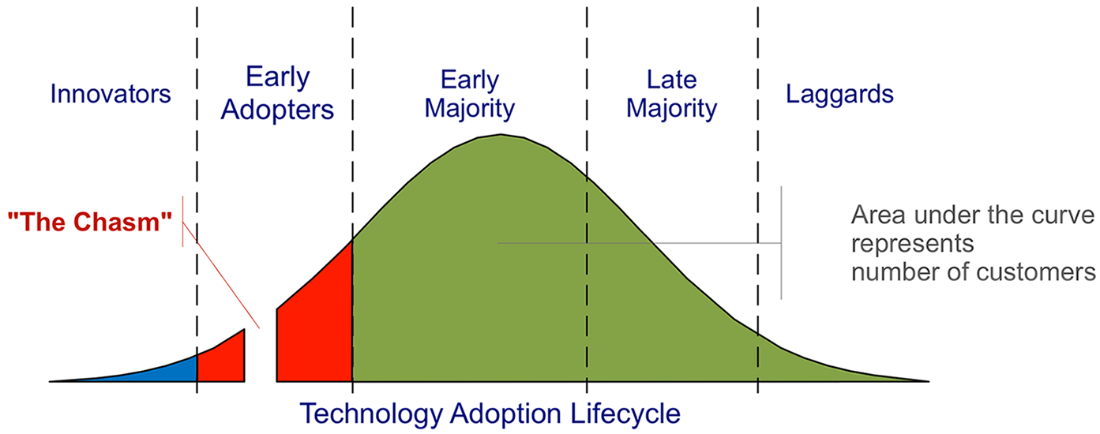
Use the adoption curve to place lighthouse customers among early adopters and see why their feedback helps prepare a product to reach the early majority. section 14.2
An MVP needs intense focus across the company. Lighthouse customers can reveal missing critical features and usability flaws, provide early revenue, and become influential advocates. Getting this right comes before proving product-market fit and building a go-to-market strategy. section 14.2 section 14.4








