A monopartite graph has one class of nodes, with relationships connecting members of that same class. A friendship graph of people and friendship relationships, or a web graph of pages and hyperlinks, are common examples. This single-type structure is a practical input for many graph algorithms. section 2.1.3 section 5.1
Start by asking whether both ends of every relationship represent the same kind of thing. A Twitter follower network qualifies because every node is a User and each FOLLOWS relationship connects one user to another. Direction can still matter: one user may follow another without a reciprocal follow. Relationships may also be unweighted while retaining properties such as their creation date. section 2.3.1 section 5.1
Model a follower network
Use a User label and a specific FOLLOWS relationship, with a unique user identifier and optional registration and relationship-date properties. This yields a directed monopartite network that can be characterized by connectedness and link density, then analyzed with centrality or community-detection algorithms. section 2.3.1 section 5.1
A bipartite graph can often be projected into a monopartite graph when indirect connections are the useful analytical signal. For tweets and hashtags, connect two tweets that share a hashtag with SIMILAR relationships, or connect hashtags that co-occur. Choose the projected node type and inferred relationship meaning to fit the domain. section 2.4.2 section 7.0
A projection commonly follows these steps:
- Select one node set from a bipartite pattern, such as hashtags connected through tweets. section 2.4.2
- Infer direct relationships from the shared intermediate nodes, such as CO_OCCURRENCE between tags. section 7.0
- Optionally assign a relationship weight, such as Jaccard similarity, based on overlap between the connected sets. section 7.2.1
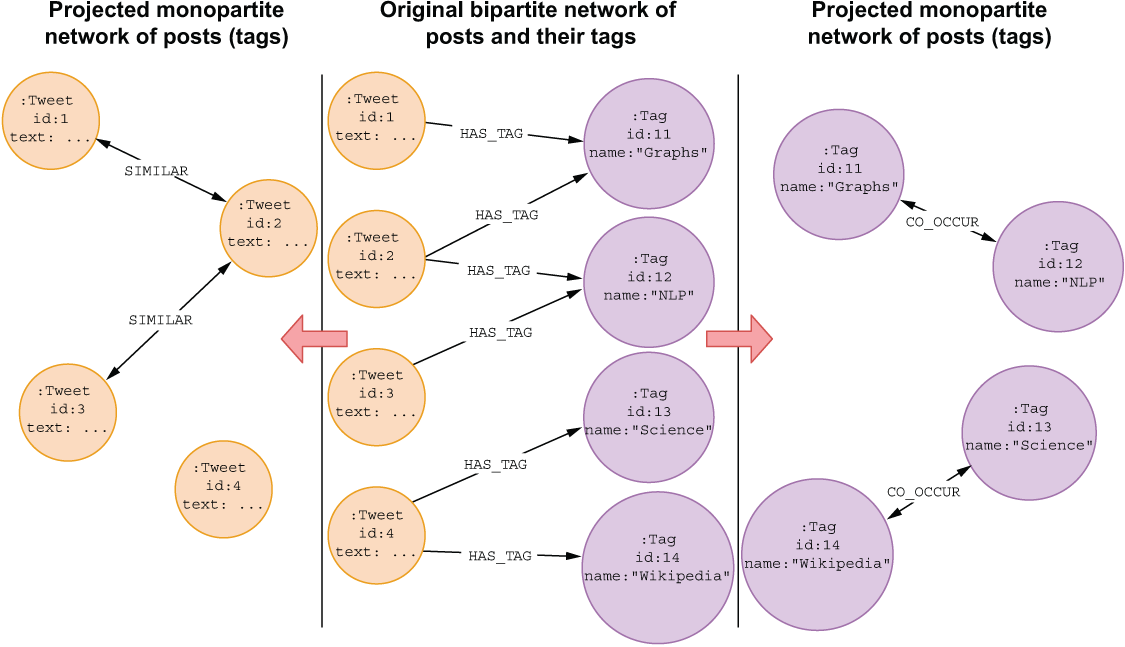
Compare the original tweet–hashtag bipartite pattern with its projected single-type network to see how shared tags become direct connections. section 2.4.2
Projection is an analytical choice, not merely a schema rewrite. A retweet pattern can become a direct AMPLIFY relationship between users, supporting analysis of influential content creators. A mention pattern can become a co-mention network for examining communities or informing follower recommendations. section 6.0 section 2.4.3

