A monopartite graph contains one node type, so every connection joins nodes of that same type. A protein–protein interaction (PPI) network is a practical example: proteins form the nodes and interactions form the edges. section 4.2.1 section 4.2.3
Use the structure to analyze a disease-specific protein subnetwork:
- Select proteins associated with a disease from the knowledge graph. section 4.2.3
- Retain PPI edges between the selected proteins, producing an undirected disease pathway. section 4.2.3
- Measure internal connectivity, density, largest-component size, and boundary connections to the full PPI network. section 4.2.3
Disease pathway
For celiac disease, associated proteins are collected and their PPI relationships extracted. The resulting monopartite subnetwork excludes disease nodes, although disease pathways can overlap through shared proteins. section 4.2.1 section 4.2.3
Figure 4.4 A disease pathway is a subgraph of the PPI network defined by a set of proteins associated with the disease.
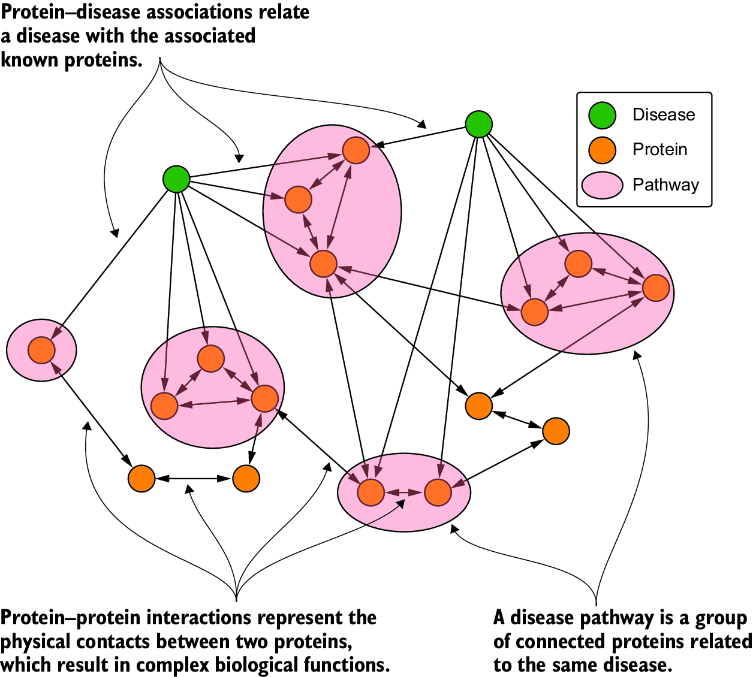
Visualizes a disease pathway as a protein-defined subgraph of the PPI network. section 4.2.1

