Network Address Translation (NAT) modifies a packet’s source and/or destination IP address, typically at a perimeter router or firewall. It lets hosts using private IPv4 addresses communicate over the internet through public addresses. section 9.2 section 9.0
Private IPv4 addresses can be reused internally but are not routable over the internet; an ISP discards packets sourced from or destined for them. NAT translates them before internet communication. section 9.1 section 9.2
PC1 reaches an internet server
PC1 sends a packet from its private address to 8.8.8.8. R1 translates PC1’s source address to a public address before forwarding it. The reply returns to that public address, and R1 translates it back to PC1’s private address. section 9.2.1
Use these operational terms and configuration rules:
- Inside and outside identify the internal and external networks; local identifies a pre-NAT perspective, while global identifies a post-NAT perspective. section 9.4
- Mark router interfaces with ip nat inside or ip nat outside; this step is required for the NAT types covered by the CCNA exam. section 9.4
- Assume private-to-public translation for CCNA questions; private-to-private and public-to-public translation is possible but has more limited use cases. section 9.2.1
Figure 9.1 Public and private IPv4 addresses. Private IPv4 addresses can be freely used for internal networks and do not have to be globally unique. Public IPv4 addresses, used for communication over the internet, must be globally unique.
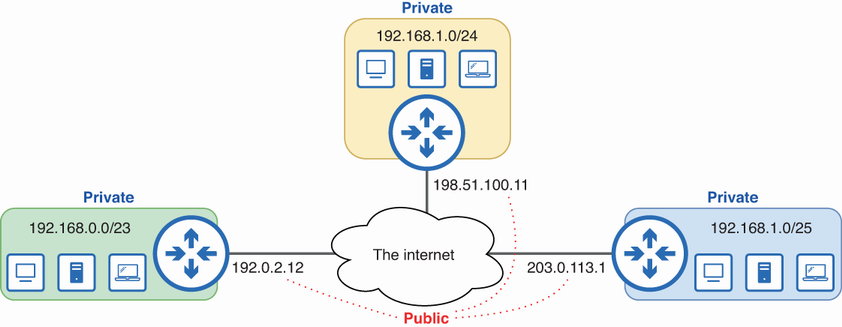
Compare reusable private IPv4 addressing with globally unique public IPv4 addressing. section 9.1
Figure 9.2 R1 translates between PC1’s private IP address and a public IP address for use over the internet.
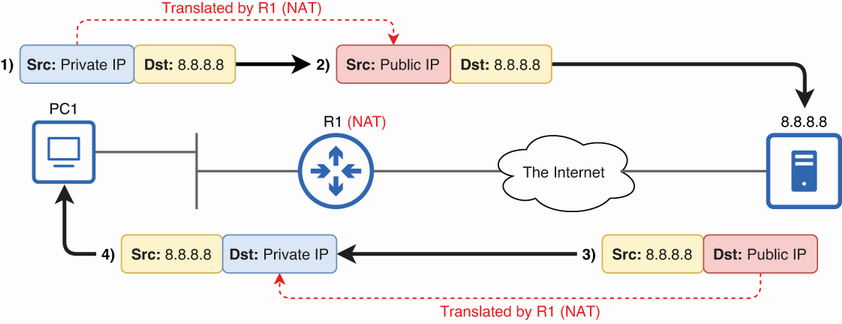
Trace the private-to-public translation path from the internal host to the internet and back. section 9.2.1

