Network bandwidth is the maximum rate at which data can be transferred across a network connection. In a ScyllaDB production cluster, it is one resource to account for alongside disk space, CPU cores, memory, and cost. section 9.2.2
Treat bandwidth as a starting point for capacity planning rather than a value determined by a universal formula:
- Test with consequence-free, production-level traffic to determine whether the cluster withstands expected demand. section 9.2.2
- Size bandwidth together with storage, replication, CPU, memory, and cost because every workload and cluster differs. section 9.2.2
- Use the resulting measurements as a baseline, then tune the cluster for actual production needs. section 9.2.2
Figure 9.5 Using smaller nodes in your cluster can be a cost-effective way to meet your throughput goals, as well as increase your cluster’s availability if you were to lose a quorum.
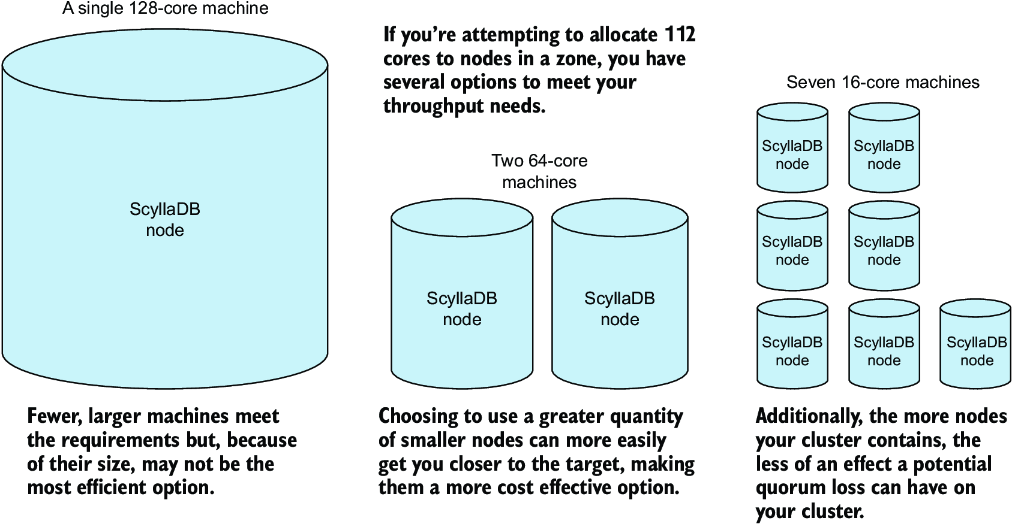
Compare smaller-node layouts when balancing throughput goals, cost, and availability during cluster planning. section 9.2.2



