A NoSQL database is a nonrelational database that stores data in flexible structures rather than fixed tables. NoSQL means “Not Only SQL”: many systems support SQL variants, but commonly expose JSON-like retrieval APIs. section 4.1.1
The main implementation differences from SQL databases are:
- Stores records in collections of documents containing flexible key/value pairs, rather than rows and columns in fixed-schema tables. section 4.1.1
- Often keeps related information inside one document, such as roles within a user document or comments within a board-game document. section 4.1.1
- Uses a different approach to relationships than SQL databases, whose records commonly connect through primary keys. section 4.1.1
Choosing a database for MyBGList
A board-game API might use NoSQL for a CSV import containing IDs, names, publication years, and related information. The decision favors SQL when the dataset is small, record structures should remain consistent, horizontal scaling is unnecessary, and the application already benefits from caching and paging. ASP.NET Core supports both approaches; the available NoSQL options include Azure Cosmos DB and third-party providers. section 4.1.2
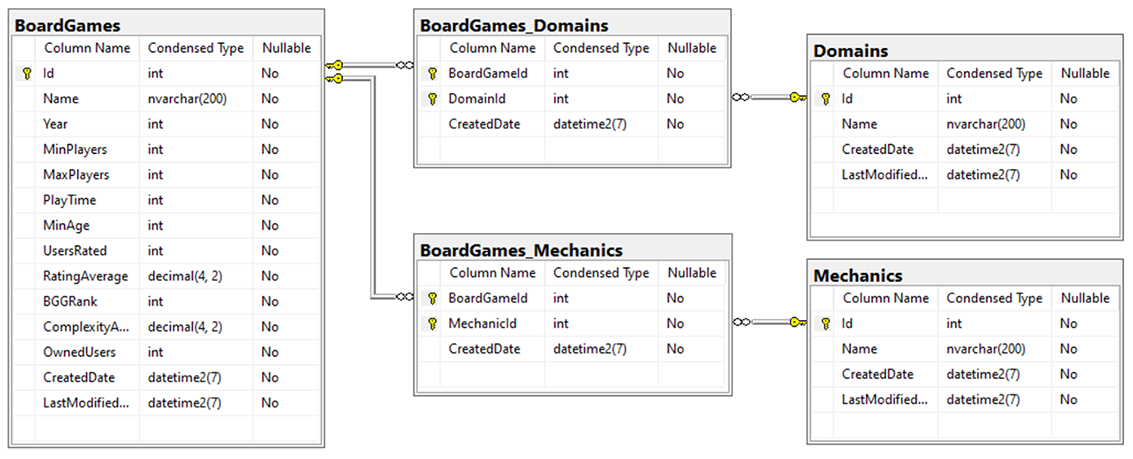
Compare the table-oriented SQL schema with its record types and relationships. section 4.1.1
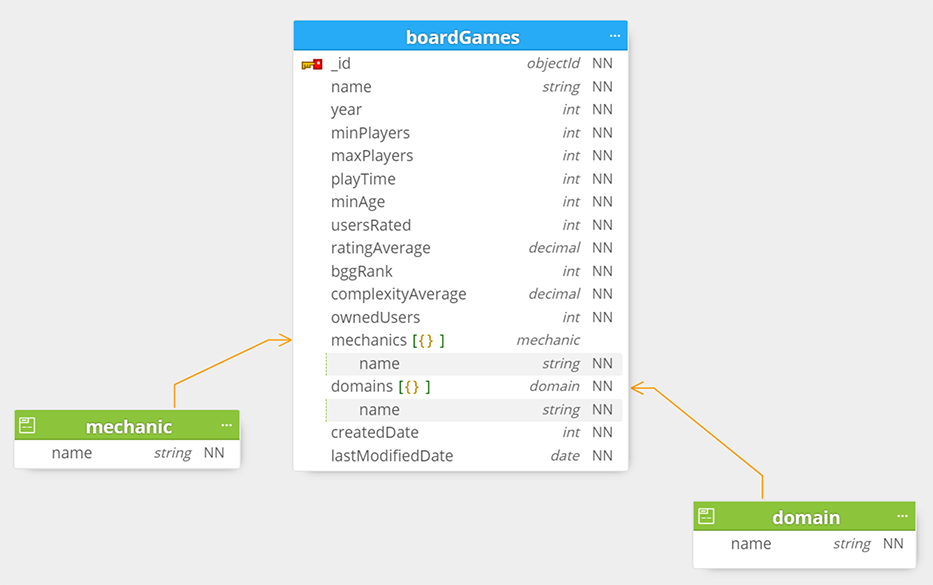
Compare the document-oriented alternative, including how related board-game information is organized. section 4.1.1






