A NoSQL database is a non-relational system that does not use the traditional relational table model. The category includes wide-column databases such as ScyllaDB, document stores such as MongoDB, and “not-only SQL” systems such as CockroachDB. section 1.1.3
ScyllaDB illustrates the wide-column model: tables may have different columns in different rows, and rows can be distributed across the database. This differs from a columnar database, which stores values from the same column together for aggregation. section 1.1.3
A distributed NoSQL database makes several design trade-offs:
- Distributes data across a cluster, improving availability when nodes fail. section 1.2.2
- Scales horizontally by adding nodes; the cluster can rebalance data onto new members. section 1.2.2
- Uses a BASE model—basic availability, soft state, and eventual consistency—instead of relational ACID guarantees. section 1.2.2
- Lets operators tune request consistency: ONE needs one responding node, QUORUM needs a majority, and ALL needs every node. section 1.4
Choosing consistency for a request
A request using ONE can remain available when some nodes are unavailable, while QUORUM balances availability and correctness and ALL requires every node to respond. These choices reflect the trade-off between consistency and availability. section 1.4
Although they have similar names, columnar and wide-column databases differ significantly in their storage paradigms. ScyllaDB is a wide-column database.
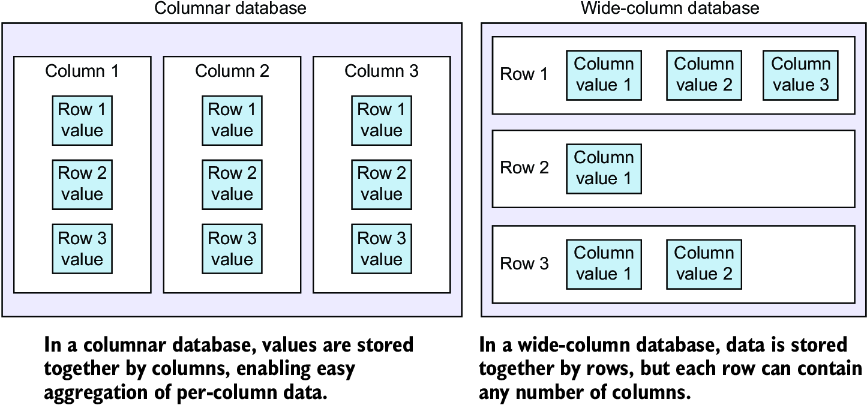
Compare columnar storage with wide-column storage to see why ScyllaDB belongs to the latter category. section 1.1.3






