A NoSQL database uses a nonrelational data model. Applications may choose one when they need a different persistence technology from a relational database; examples include MongoDB, Cassandra, Redis, and Neo4j. section 5.2.1 section 8.4
For log storage, NoSQL databases can favor performance over consistency: messages may be missed or stored out of chronological order. Include a timestamp in each message so its timing remains available. ELK and Splunk are examples of engines used to store, retrieve, search, and analyze logs. section 5.2.1 section 5.2.1
Inspecting MongoDB operations
A small app writes a product to MongoDB and reads the product list. JProfiler can intercept these operations and show invocation counts, execution times, and the stack traces leading to them. section 8.4 section 8.4
Figure 8.21 JProfiler can intercept the operations an app applies to a NoSQL database. In this example, JProfiler intercepts two events: an update and a read on a document named “product.” This way, you can monitor the interaction between your app and a NoSQL database and consider the number of invocations for specific operations and the execution time. The profiler also gives you the complete stack trace for a particular operation so you can quickly find the code that caused a specific event.
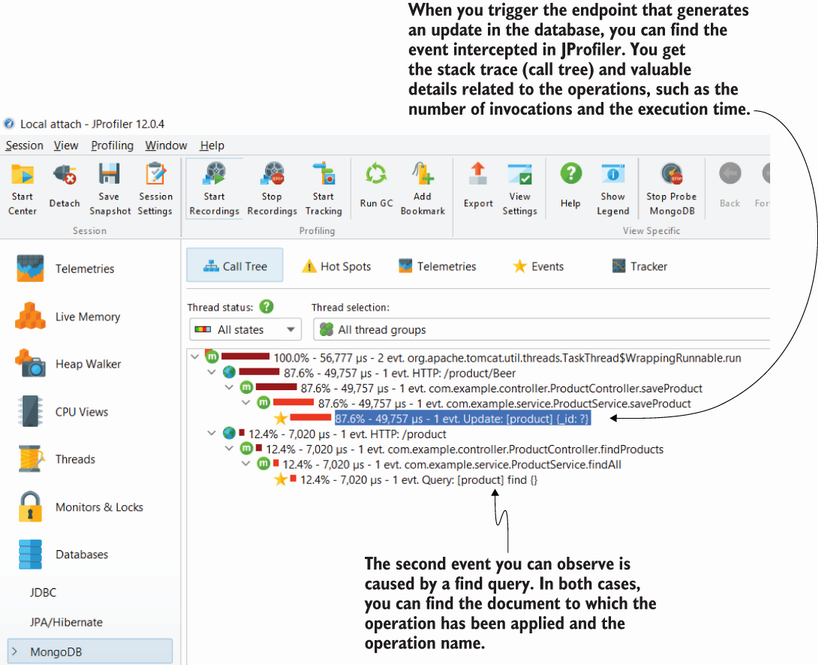
See the intercepted MongoDB update and read events, including the profiler details available for each operation. section 8.4