liveBook · Manning

One-to-many relationship

As explained in 100 SQL Server Mistakes and How to Avoid Them

A one-to-many relationship is an association in which one record in an entity can be associated with multiple records in another entity.

A one-to-many relationship links one record in one entity with multiple records in another. Recognizing it helps avoid storing repeated item data in a single record. section 4.1.1

Sales order items

A sales order can contain more than one product. Model the order and its ordered items as separate entities, then connect each item to the relevant product in Products. section 4.1.1

Use keys to connect the entities: a primary key uniquely identifies a row, while a foreign key points to a primary key or unique constraint and supports referential integrity. section 4.1.1

Figure 4.1 ERD for Sales Orders
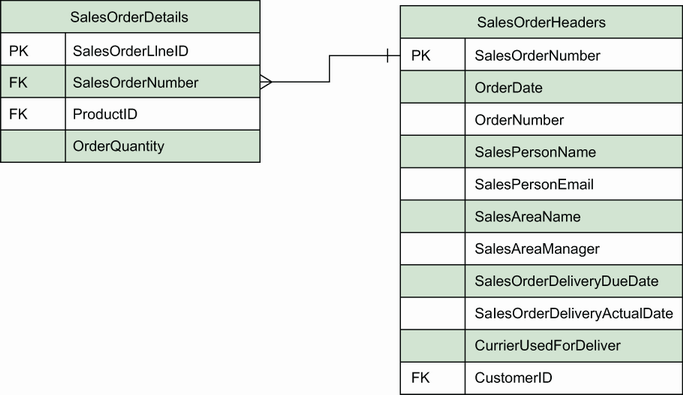
Use the sales-order ERD to inspect how the order, item, and product entities are separated and related. section 4.1.1


How 100 SQL Server Mistakes and How to Avoid Them covers it

How deep it goes
Defines the relationship and applies it to entity separation, keys, and referential integrity without detailing queries or implementation commands.
Examples
Illustrates sales orders containing multiple products and employees associated with offices through keys.
What it assumes
Assumes basic entities and records, while defining primary keys, foreign keys, and referential integrity.
What you can do after
Apply it by separating repeating sales-order items and linking records with primary and foreign keys.
How it connects
Connects one-to-many relationships with entities, primary keys, foreign keys, unique constraints, and referential integrity.

Also explained in

Compare how 12 books explain one-to-many relationship →

Related concepts

This explainer was generated by Manning's knowledge graph from the text of 100 SQL Server Mistakes and How to Avoid Them. The section links point to the parts of the book it draws on.









