Suppose several agent prompts work well, but the higher-quality ones cost more to run. Keeping only one “best” prompt hides a useful choice. The Pareto frontier, or Pareto front, keeps the candidates that offer distinct trade-offs instead. section 4.2.3
Find the front with a pairwise test:
- Candidate X dominates Y if X is at least as good on every objective and strictly better on at least one. section 4.2.3
- Drop each candidate dominated by another. Keep every candidate that remains; none can be replaced without giving something up. section 4.2.3
Quality versus cost
Higher quality is better; lower cost is better. A scores 0.90 at cost 9, B scores 0.80 at cost 4, and C scores 0.60 at cost 2. All three stay: moving toward higher quality means paying more. D (0.70, 9) falls to B, which is both better and cheaper. E (0.50, 5) falls to C for the same reason. The survivors form a staircase of choices, not a ranking with one winner. section 4.2.3
Listing 4.4 The domination test and the front (02_pareto_demo.py)
# (name, quality: higher is better, cost: lower is better)
CANDIDATES = [("A", 0.90, 9), ("B", 0.80, 4), ("C", 0.60, 2),
              ("D", 0.70, 9), ("E", 0.50, 5)]

def dominates(x, y) -> bool:                             #A
    at_least_as_good = x[1] >= y[1] and x[2] <= y[2]
    strictly_better  = x[1] >  y[1] or  x[2] <  y[2]
    return at_least_as_good and strictly_better

def pareto_front(candidates):                            #B
    return [c for c in candidates
            if not any(dominates(o, c) for o in candidates
                       if o is not c)]
The Python listing implements the two-part domination test, then retains candidates for which no other candidate passes it. section 4.2.3
Figure 4.6 The front is the frontier of best trade-offs. Five candidates are scored on quality (up) and cost (across). A, B, and C sit on the front, each the best at some trade-off, so nothing beats them on both and all three are kept; D and E fall in the shaded dominated region, beaten on both axes at once, and are dropped.
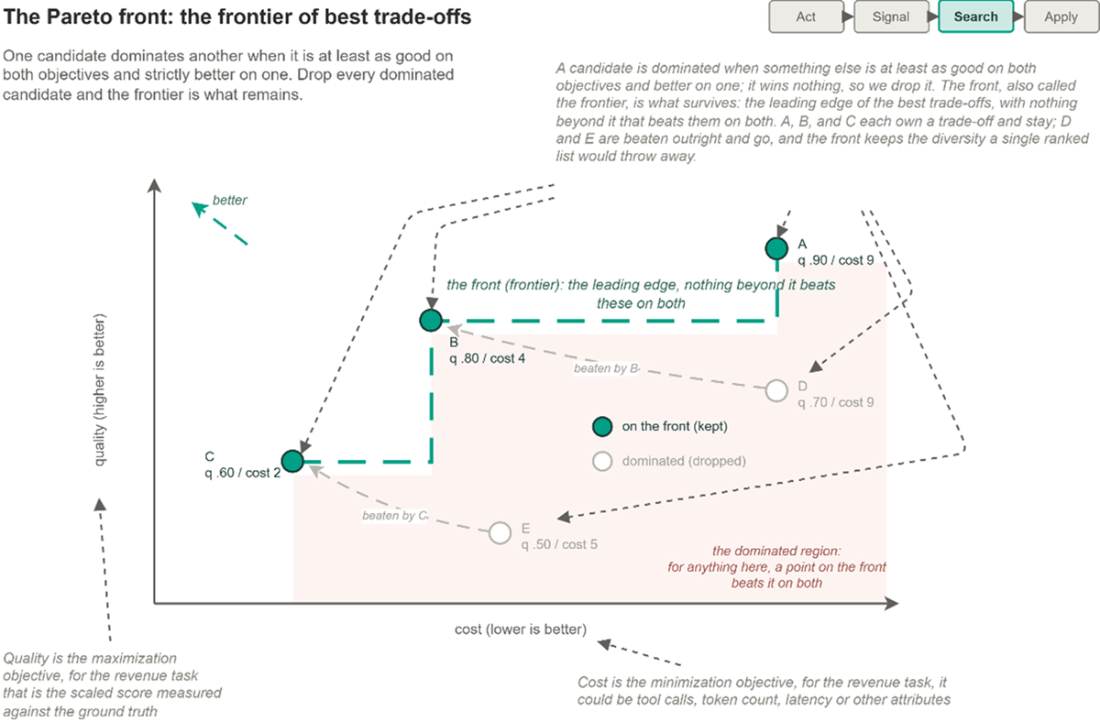
The diagram makes the staircase visible: each surviving point offers a trade-off, while dominated points sit behind the frontier. section 4.2.3
In a population-based prompt search, keeping the whole front preserves alternatives for later variation rather than carrying forward only one winner. The distinction matters only when there are multiple objectives: with a single score, the front collapses to a ranked list. A practical next check is to add a candidate that dominates an existing survivor, then one that joins the staircase without displacing anyone. section 4.2.1 section 4.2.3 section 4.5