Personalization adapts recommendations to individual viewing history and preferences rather than relying primarily on demographic patterns or general popularity. Evaluating it requires separating relevant individual-level adaptation from algorithmic bias. section 3.1.1 section 3.4.6
A practical diagnostic workflow is:
- Create synthetic users with identical preferences while varying demographic attributes to isolate model-driven differences. section 3.1.1
- Compare recommendation distributions across groups using subgroup analysis, visualizations, and fairness or bias indicators. section 3.1.1
- Recheck patterns against real user preferences so legitimate usage differences are not mistaken for bias. section 3.1.1
- Rerun diagnostics after changing feature weights, embeddings, or the balance between popularity and personal history. section 3.4.6
Premium subscribers and indie films
A streaming service finds that premium subscribers who regularly watch indie films and documentaries receive mainstream blockbusters. The model overweights popularity despite extensive viewing histories. Increasing genre-affinity weights, creating a cinephile-focused content embedding space, or rebalancing popularity against personal history can improve relevance; diagnostics then check whether the change helps valuable subscribers without harming casual viewers. section 3.4.6
Figure 3.1 illustrates the input-output framework for diagnostic offline evaluations, showcasing how data, design, and metrics work together to identify potential issues in machine learning models. The input consists of data, such as historical interactions, user metadata, and labeled outcomes, which provide the foundation for the evaluation. The design process defines how this data is analyzed, using tools like subgroup analysis or visualization techniques, to produce actionable metrics like fairness scores or bias indicators as the output.
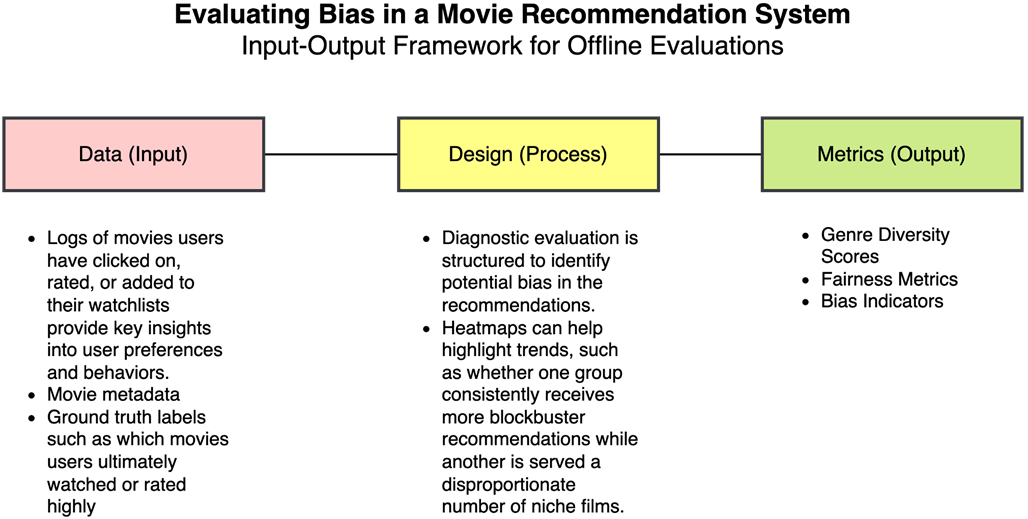
Use the input-output framework to connect historical interactions, user metadata, and labeled outcomes with subgroup analysis and actionable fairness or bias metrics. section 3.1.1










