Phishing is bait-based fraud: an attacker poses as a trusted entity, prompts a person to act, captures sensitive credentials, and uses them to commit fraud. The deception relies on a trusted substrate—such as a delivery service—while the victim is the genuine participant being manipulated. section 1.1 section 1.5.1
Parcel-delivery lure
A fake UK Royal Mail page asked for a name, phone number, and a one-time password. Inspection of its network traffic showed submitted details being sent as a Telegram message to a bot, illustrating how an apparently authentic delivery request can collect information for later financial harm. section 1.1
Figure 1.2 A screenshot of a fraudulent UK Royal Mail webpage asking for a one-time password received on my mobile phone - a classic example of a parcel delivery phishing attack
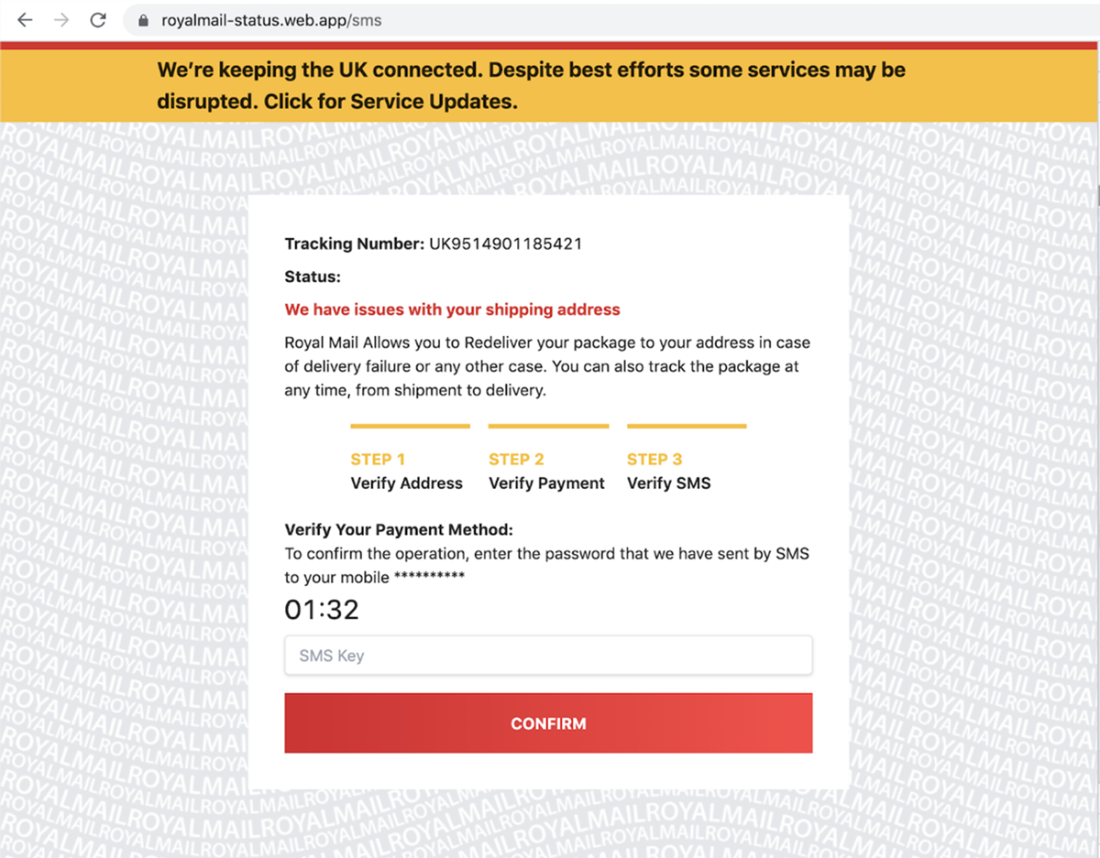
The fraudulent page makes the requested one-time password visible as the attacker’s immediate target, grounding phishing in a realistic delivery-service impersonation. section 1.1
The same pattern appears across communication channels. Email phishing uses email, smishing uses SMS, and vishing uses voice calls. Each seeks attention through an apparently authentic request: clicking a link, following an SMS link, or disclosing card information by phone. section 1.5 section 1.5.1
For detection, phishing can be examined through three complementary lenses:
- Industry or domain: phishing is pervasive in finance, e-commerce, logistics, and other services that contact users. section 1.5 section 1.5.1
- Attack nature: identify suspicious sender and delivery patterns, such as unusual IP addresses, suspicious voices, or unusual SMS timing. section 1.5.1
- Data modality: use structured metadata alone, or semi-structured data that combines metadata with communication content. section 1.5 section 1.5.1
Useful inputs include email or SMS text, phone-call audio, sender email domains, caller country codes, network-provider details, IP addresses, and message timing. Those inputs also shape deployment: detection may run on email servers, mobile devices, or mobile-network servers. section 1.5.1
A practical baseline is a fixed-rule detector. The workflow is to analyze a phishing dataset, curate rules, evaluate their performance, and package them in an executable Python program. This establishes the fraud-detection lifecycle before applying the approach to other fraud problems. section 2.0






