liveBook · Manning

Poisson distribution

As explained in Machine Learning System Design

A probability distribution for the count of events occurring independently at a constant average rate in a fixed interval or exposure.

The Poisson distribution appears here as a practical shortcut for bootstrap validation. When the dataset is much larger than 100, Poisson(1) closely approximates binomial(n, 1/n), allowing observations to be sampled independently without tying the procedure to dataset size. section 7.4

Faster bootstrap validation

Replacing multinomial sampling with independent Poisson(1) sampling made bootstrap validation easy to parallelize and reportedly increased speed by roughly 100–1,000 times with additional techniques. section 7.4

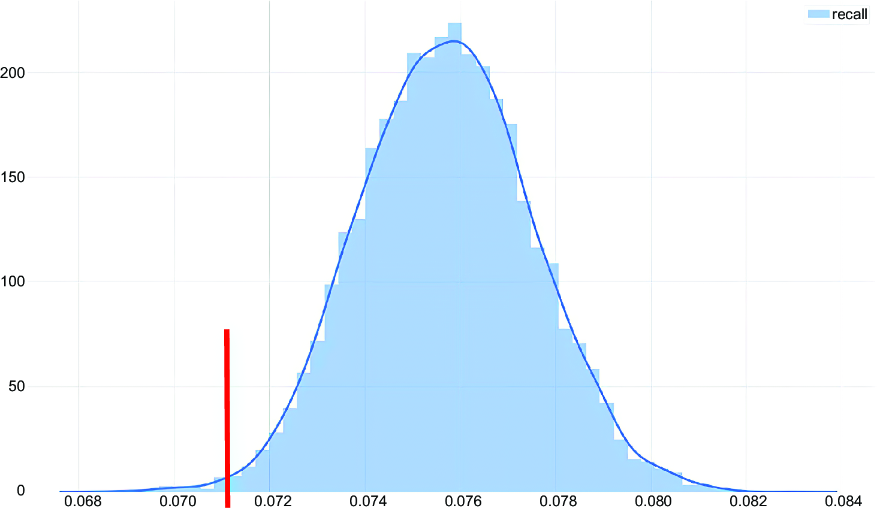
Distribution recall with every point being a bootstrapped original dataset; the red line is a 99% lower confidence bound.
sidebar figure

Use the recall distribution and its 99% lower confidence bound to see how bootstrap samples support metric-confidence estimates. section 7.4


How Machine Learning System Design covers it

How deep it goes
Approximates binomial(n, 1/n) with Poisson(1) for large datasets but does not derive the distribution generally.
Examples
Uses Poisson(1) bootstrap samples to estimate distributions and a 99% lower confidence bound for recall.
What it assumes
Assumes familiarity with bootstrap, multinomial and binomial sampling, validation metrics, and confidence bounds.
What you can do after
Apply it via independent Poisson(1) sampling to parallelize large-scale bootstrap validation.
How it connects
Connects Poisson sampling with bootstrap, binomial distribution, multinomial sampling, confidence bounds, precision, and recall.

Also explained in

Compare how 7 books explain Poisson distribution →

Related concepts

This explainer was generated by Manning's knowledge graph from the text of Machine Learning System Design. The section links point to the parts of the book it draws on.




