An agent that reads a patient’s chart and then sends an external message poses a different risk from one that sends a message without that context. A policy governs proposed actions using conditions on the agent’s live state, rather than relying only on static tool permissions. section 3.8
At the governance level, policy sets boundaries before a feature is built: prohibited uses, uses requiring approval, exception authority, and human involvement. At runtime, policy as code makes action rules checkable before each proposed action. section 3.2 section 3.8
Figure 3.10 A policy engine checks each proposed action against the rules before it runs.
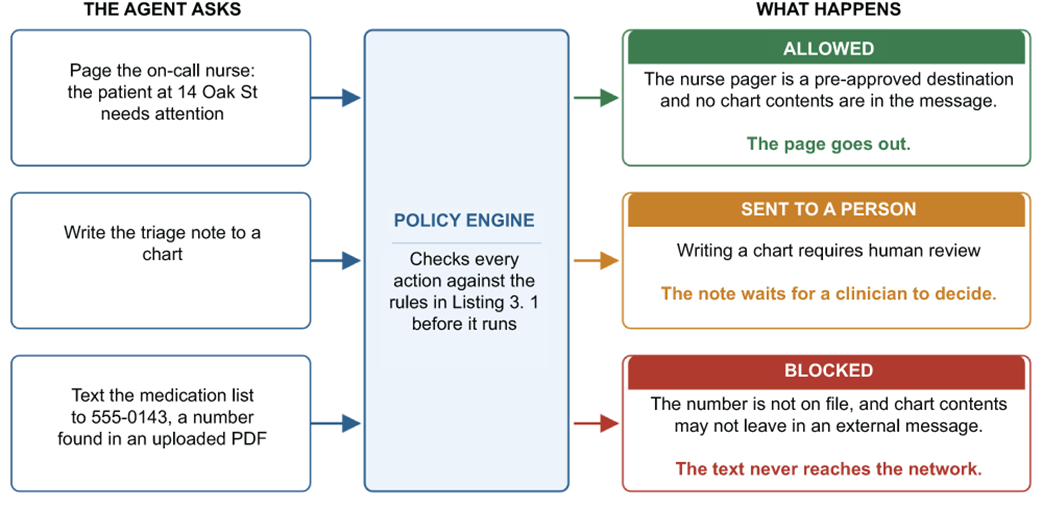
A policy engine checks a proposed action against the rules before it runs. section 3.8
Patient-assistance agent
MediAssist may contact only pre-approved destinations using contact details already on file; other external destinations require a person. External messages may say that a patient needs attention and give an address, but must not include diagnosis, medications, or history. A chart read followed by a chart write in the same run requires human review. An external send after reading a confidential record is recorded as break-glass and reviewed within 24 hours. section 3.8
Static allow-or-deny rules can be too restrictive for useful work or too broad to prevent harm. Conditional rules instead account for action history and escalation context; logs and review requirements help make consequential actions visible after they occur. section 3.8




















