A pose specifies where an object is and how it is oriented relative to a reference or coordinate system. Position alone is not enough: an object can remain at the same coordinates while its orientation changes. In software, pose is represented with numeric values so it can be calculated with, compared, and used to describe motion. section 6.1.1 section 6.1
Keep pose separate from shape. Shape describes occupied space, size, and outline; pose describes the object’s whereabouts. The needed pose parameters depend on the dimensions of the space: a 3D object in 3D space can require three translations and three rotations. section 6.1.1 section 2.4.1
For a stationary manipulator, pose connects the software command to physical robot parts:
- The end effector is the last link or attached tool; it is the part moved to different positions in space. section 2.3.1
- The pose refers to the flange when no tool is mounted, and to the tool center point (TCP) when a tool is mounted. section 2.4.1
- A target pose must be converted into joint-motor positions before the robot can execute motion. section 1.2.4
Commanding an end-effector pose
A call such as robot.move(pose) expresses the intended endpoint at a high level. Planning then determines intermediate joint positions that place the gripper at that target pose. A rectangular motion can be expressed as a sequence of 2D poses and executed with linear moves between them. section 2.3.1 section 1.2.4
The route to a pose matters as well as the endpoint. A linear path is geometrically shortest, while a point-to-point path is more natural, shorter, and easier for actuators to follow. Point-to-point motion uses inverse kinematics to obtain target joint positions, then commands each joint. section 2.3.1
Figure 2.10 An example of a 2D pose, showing how an object’s state in space requires both a position and an orientation, since a change in orientation is significant even if the position remains identical.
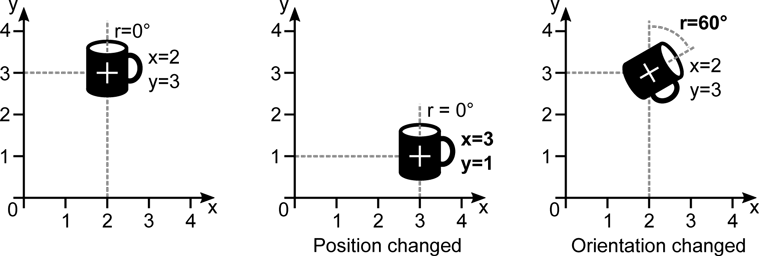
Compare two states with identical position but different orientation to see why pose includes both. section 2.3.1


