Quality of service (QoS) prioritizes important traffic during congestion and de-prioritizes less important traffic. It protects delay-sensitive applications such as voice and video when bandwidth is limited, reducing delay, jitter, and packet loss. section 10.0 section 10.2.2
Use these terms to describe QoS behavior:
- Classify packets by traffic type, such as real-time, business-critical, default, or scavenger traffic. section 10.3.1
- Mark packets so later devices can classify them efficiently from header fields rather than repeating complex inspection. section 10.3.2
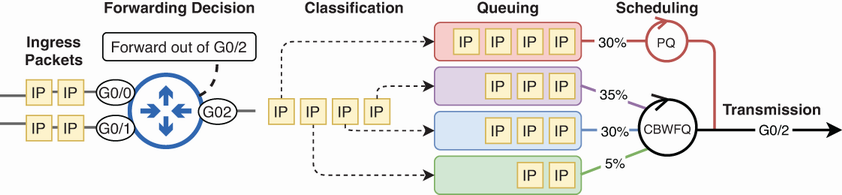
- Queue packets when they arrive faster than an interface can transmit them, then schedule their transmission order. section 10.2.3 section 10.4
- Apply scheduling methods such as Priority Queuing (PQ), Class-Based Weighted Fair Queuing (CBWFQ), or Low Latency Queuing (LLQ). section 10.2.3 section 10.4
Recognize the principal marking mechanisms:
- Use DSCP in IPv4 or IPv6 headers; its six bits provide 64 values and carry end to end unless modified. section 10.3.3
- Use PCP, also called CoS, in the three-bit 802.1Q tag; voice commonly uses decimal 5, while best effort uses 0. section 10.3.2
- Recognize standardized DSCP examples: DF is decimal 0 for best effort, and EF is decimal 46 for delay-, jitter-, and loss-sensitive traffic. section 10.3.3
Separating voice and data on an access port
Configure a PC and IP phone to share a switch port while keeping their traffic in separate VLANs: interface range f0/1-3 switchport mode access switchport access vlan 10 switchport voice vlan 20 The data VLAN is untagged, the voice VLAN is tagged, and the port remains an access port. Verify the result with show interfaces f0/1 switchport; the output should show Access Mode VLAN: 10 and Voice VLAN: 20. section 10.1.1
Figure 10.7 The QoS big picture. A router receives packets and makes a forwarding decision for each, classifies the packets based on their type, queues them for transmission, and uses scheduling methods to determine the order of transmission.
Trace the QoS pipeline from forwarding through classification and separate queues to scheduled transmission. section 10.2.3

