If an assistant helps plan your week, remembering your time zone can spare you from repeating it every Monday. Memory is the ability to retain useful information and bring it into later interactions or steps of a task. It can make assistance more consistent, but remembering something is not the same as recalling it reliably or using it appropriately. section 10.4
Memory serves two related purposes:
- Within a task, an agent can keep intermediate results available while it searches, uses tools, and decides what to do next. It may retain a search’s final result rather than every document returned. section 8.12
- Across interactions, an assistant can retain earlier discussions, project details, or user preferences. This persistent memory supports continuity without requiring the user to repeat everything. section 8.12 section 8.3
Keeping all available information is not necessarily useful. Long chains of tool calls produce more results than an agent may need, so developers must choose what to retain and what to discard. Personalized assistants can also draw on extended context, semantic memory, and retrieval systems to bring past information into a response. These are ways to support recall, not guarantees that the right detail will appear at the right time. section 8.12 section 10.4
A continuing planning task
An assistant that knows a user’s time zone and usual planning tools can help schedule another week without asking for those details again. In a longer task involving several searches, it could keep each search’s useful conclusion while dropping the full set of retrieved documents. section 10.4 section 8.12
Figure 10.1 Structured memory graph for personalized AI
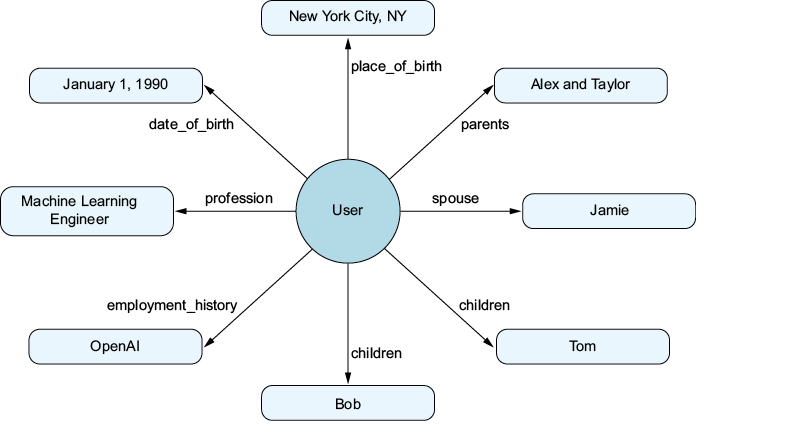
A structured memory graph offers one way to picture a persistent user profile: attributes, preferences, and relationships linked to an identity. section 10.4
Persistence also raises questions of control. Recall can be inconsistent, and memory may be tied to one vendor or device. Users may want to inspect, edit, limit, transfer, reset, or delete what an assistant remembers. Remembered confessions or preferences can make a social chatbot feel unusually intimate, potentially intensifying dependency; a helpful sense of continuity should not be mistaken for a human relationship. section 10.4 section 10.24 section 10.13
For agents that act across multiple steps, corrupted memory can also lead behavior off track. Evaluating memory therefore means looking beyond a single answer: testing consistency across sessions, probing for corruption, and examining how retained information affects later actions. section 8.17 section 10.22













