A random forest combines multiple decision trees into one ensemble model. Each tree examines different data attributes and votes on whether an item is safe or a threat; agreement across trees supports the final classification. section 12.3
For cybersecurity classification, a random forest can:
- Analyze email sender information, writing patterns, attachments, IP addresses, traffic volume, or unusual login attempts. section 12.3 section 12.3.1
- Learn from labeled historical data and classify network activity as benign or malicious. section 12.3.1
- Support proactive detection by recognizing patterns associated with anomalies, advanced persistent threats, and potential vulnerabilities. section 10.3.4
Figure 12.3 Elements of a decision tree
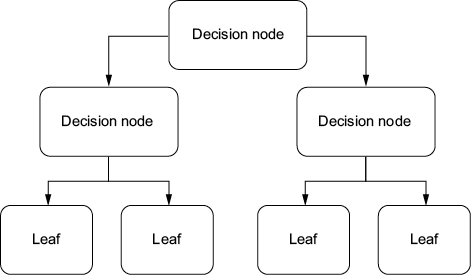
Use the decision-tree diagram to follow decision nodes, branches, leaf outcomes, and the path from a root decision to a classification. section 12.3.1
Login-activity threat detection
A Python exercise generates login hours and failed-attempt counts, labels activity as malicious when the hour is late or attempts are high, then trains and tests a random forest. The reported random-forest accuracy is 1.0 on 30 test records, compared with 0.87 for SVM; these results describe the exercise dataset rather than a universal performance guarantee.










