A repository is a structured collection of project files and directories managed as a unit. It provides the boundary for asking cross-file questions about architecture, training, configuration, or deployment. section 2.2
Choose a repository-analysis strategy by measuring its size and noise:
- Dump small repositories wholesale; skip tests, documentation, examples, and vendored code when the core needs more context. section 3.2.1
- Scope borderline or very large repositories to a subsystem when file-level filtering cannot fit or distinguish the core logic. section 3.2.1
- Serialize a repository with a dependency-free crawler that walks directories, keeps selected extensions, skips noise directories, and labels each file. section 2.2
nanoGPT repository dump
Running `git clone ...nanoGPT.git` followed by `python crawl.py nanoGPT/ nanoGPT-dump.txt` produces a labeled dump of 19 files, including model.py, train.py, sample.py, data preparation, and configuration. section 2.2
Figure 2.2 Paste the files relevant to your question. A question about a single file's internals needs only that file. An end-to-end question needs the whole pipeline. A deployment question needs infrastructure files.
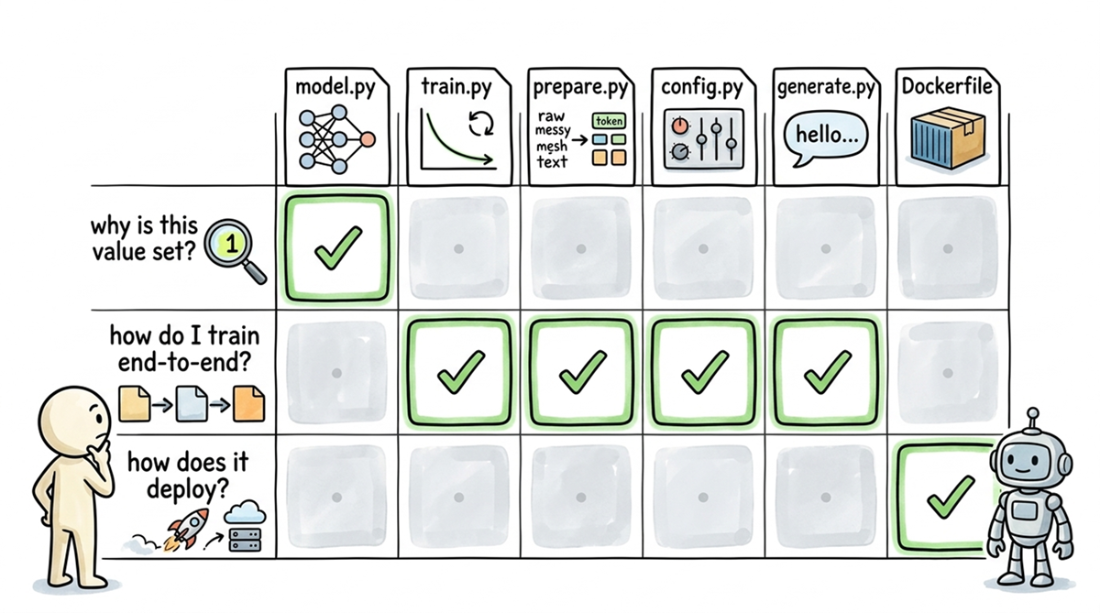
Match the pasted scope to the question: one file for internals, the whole pipeline for end-to-end behavior, and infrastructure files for deployment. section 2.2