Continuous reconciliation repeatedly compares the declared API gateway configuration in an environment repository with the deployed configuration, then corrects drift by applying the declared state. section 1.5.6
A reconciliation workflow typically:
- Stores API gateway and service configuration declaratively in Git. section 1.5.6
- Uses software agents to compare desired configuration with deployed state in each environment. section 1.5.6
- Raises an alert or automatically deploys the desired state when divergence is detected. section 1.5.6
- Routes changes through Git pull requests and CI/CD checks rather than manual gateway administration. section 1.5.6 section 1.7
- Restores a previous working configuration with a git revert when a configuration failure occurs. section 1.7
Correcting gateway drift
An engineer changes gateway configuration directly through an administration UI, causing the deployed state to diverge from the Git repository. The reconciliation agent detects the drift and redeploys the repository’s desired state. Because direct UI changes are prohibited, the durable change must instead arrive through a reviewed Git pull request; a faulty approved change can be reversed with git revert. section 1.5.6 section 1.7
Figure 1.4 APIOps is based on the GitOps approach of having the desired configuration state of the API gateway, and services are defined declaratively in an environment repository in Git. Dev teams make all changes to the desired system state via Git, and operations teams can review and approve. Software agents automatically detect any difference between the deployed state and the desired state (as defined in the environment repository). If the agent detects a drift, it automatically deploys the desired state to the specified environment so the actual state matches.
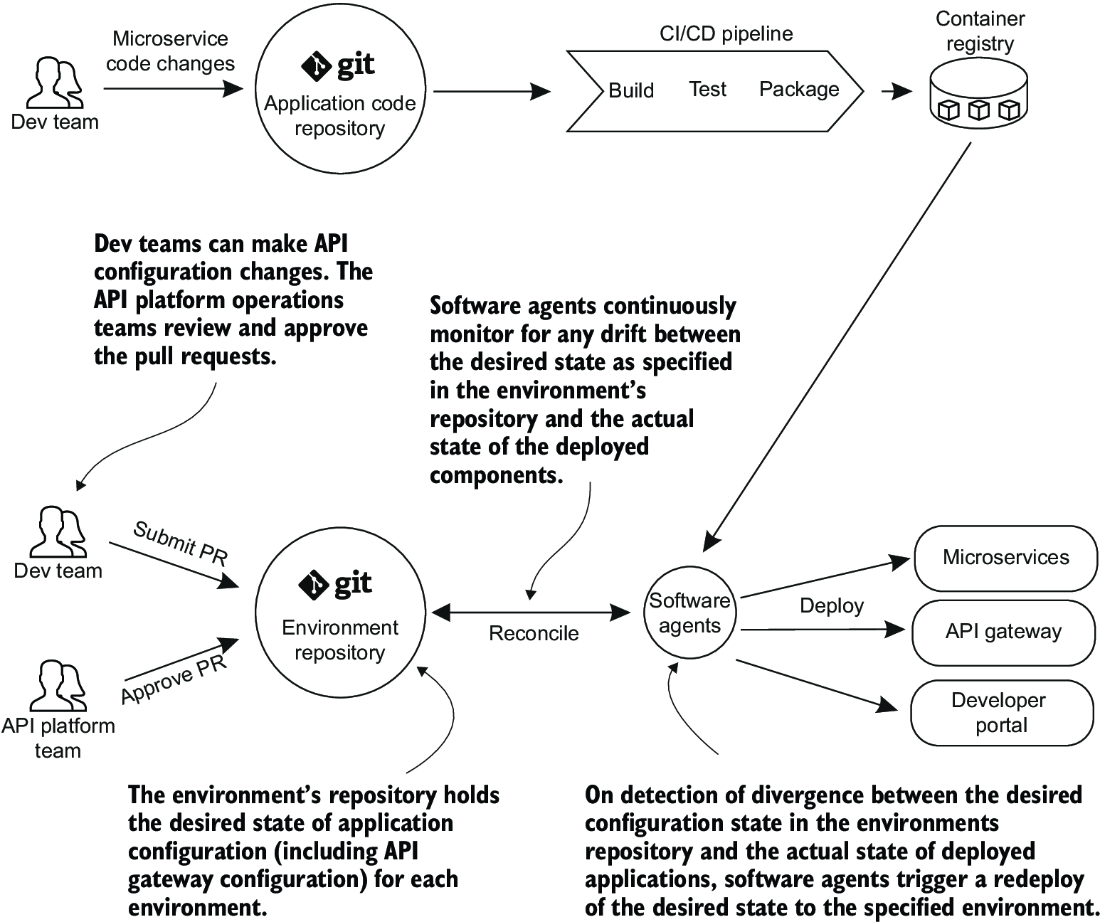
The diagram connects declarative Git configuration, reviewed developer changes, agent-based drift detection, and automatic deployment to the target environment. section 1.5.6






