Reconciliation is a repeated control process: a controller observes actual state, compares it with desired state, and makes corrective changes until they match. This loop lets Kubernetes maintain workloads without requiring every change to be performed manually. section 14.3.1 section 14.5
A reconciliation loop typically performs these operations:
- Observe the owning object and its dependent objects after a change. section 14.3.1
- Compare the observed resources with the desired configuration, such as a requested replica count or one pod per node. section 14.3.1 section 17.1.1
- Create, remove, or otherwise adjust dependent objects to correct the difference. section 14.3.1 section 17.1.1
- Repeat the process when resources change, undoing conflicting direct changes when necessary. section 14.5 section 16.4.2
ReplicaSet replica repair
A ReplicaSet specifies a desired number of pods. If fewer pods exist, its controller creates replicas from the Pod template; if too many exist, it deletes the excess. Changing the replica count causes the controller to repeat the same correction process. section 14.3.1 section 14.5
Operator-managed MongoDB
An operator reconciles a MongoDBCommunity object by creating and maintaining a StatefulSet, Services, and Secrets. Updating the members field causes the operator to scale the StatefulSet and reconfigure the MongoDB replica set. section 16.4.2
Figure 14.5 A controller's reconciliation control loop
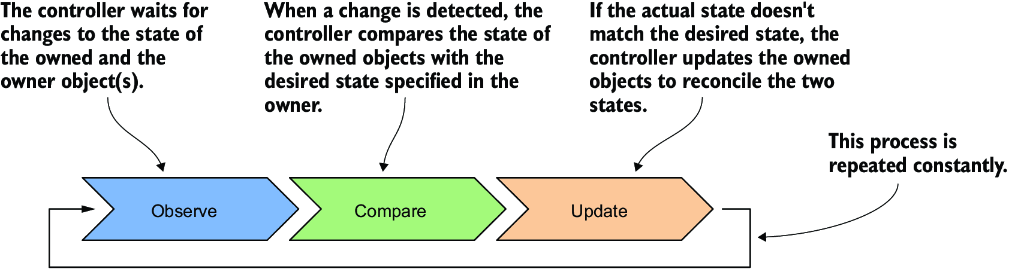
Use the controller-loop diagram to trace observation, desired-state comparison, and corrective action as a repeating lifecycle. section 14.3.1






