Reconciliation brings recorded or desired infrastructure configuration into agreement with actual infrastructure state. In infrastructure as code, it repairs drift caused by manual or break-glass changes by capturing the change in configuration and applying it consistently. section 11.3.1 section 7.1.4
Apply reconciliation as an operational sequence:
- Identify drift between infrastructure and infrastructure-as-code configuration. section 11.2.3
- Reconstruct the current state from manual commands, server history, or infrastructure metadata. section 11.3.1
- Encode the reconstructed state in infrastructure as code and apply it to testing. section 11.3.1
- Test the change, update application configuration, and push the verified configuration to production. section 11.3.2
- Compare testing and production first when their differences would otherwise make drift repair unreliable. section 11.3.2
Repairing a Cloud SQL Auth proxy drift
A break-glass change left production using the Cloud SQL Auth proxy while testing connected directly to the database. Reconstruct the proxy installation from the production server, place it in the testing server’s startup script, test the database connection, update the application to use localhost, and apply the verified configuration to both environments. section 11.3.1 section 11.3.2
Figure 11.8 You use IaC to troubleshoot your broken change by checking for drift, unexpected dependencies, and differences between testing and production.
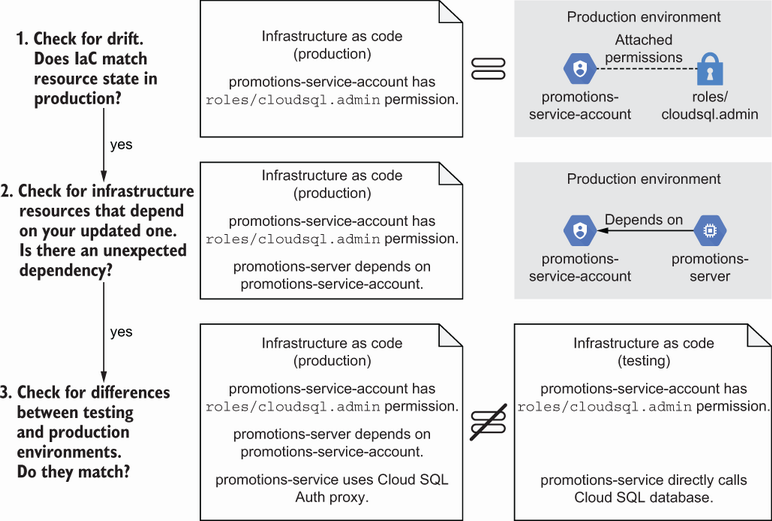
Use the troubleshooting flow to inspect drift, unexpected dependencies, and testing-versus-production differences before implementing a long-term fix. section 11.2.3






