Reconstruction loss measures the difference between an input image and the image reconstructed from its latent representation. It trains an encoder–decoder system to preserve useful visual information rather than merely compressing data. section 9.1.1 section 11.2.1
A typical image-reconstruction workflow proceeds as follows:
- Pass an image through the encoder to obtain a latent representation. section 11.2.1
- Decode the latent representation into a reconstructed image. section 9.1.1
- Compare the original and reconstructed images; one described autoencoder uses mean absolute error across all pixels. section 11.2.1
- Propagate the loss backward to update encoder and decoder parameters over repeated training epochs. section 11.2.1
The role of reconstruction loss changes across architectures. A traditional autoencoder focuses solely on reconstruction, whereas a VAE combines it with KL divergence to shape a smooth latent distribution. A VQ-VAE combines it with quantization loss after replacing continuous latent vectors with codebook entries. section 11.2.2 section 11.3.2
High-resolution image reconstruction
An image can be compressed from 3 × 512 × 512 pixels into a 4 × 64 × 64 latent representation, then decoded back to the original image space. Reconstruction loss evaluates how faithfully that decoding preserves the input. section 9.1.1
Figure 11.3 The architecture and training workflow of an autoencoder designed to generate high-resolution color images by using its two primary components: an encoder (shown on the left) and a decoder (shown on the right)
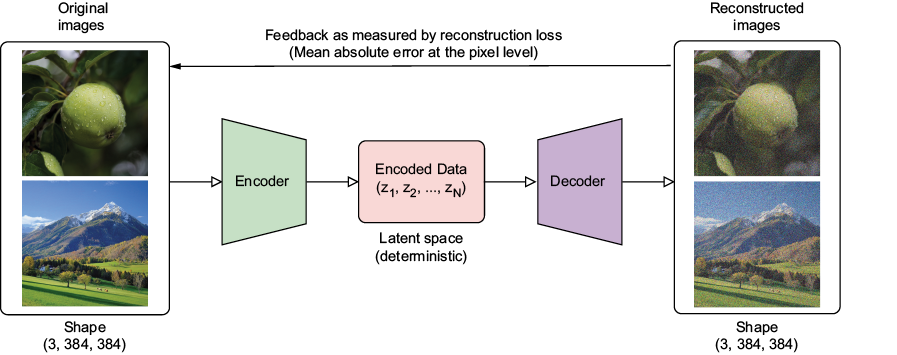
Use the architecture diagram to trace the encoder, latent vectors, decoder, pixel-wise loss, and parameter updates as one training loop. section 11.2.1









