When a library system’s data is designed separately from its code, an entity-relationship diagram makes the structure explicit. It identifies entities, refines their fields, and distinguishes association from composition relationships. section 3.1 section 2.2
A practical design proceeds by making each relationship representable in data:
- Group entities such as books, authors, users, members, and librarians into high-level areas. section 2.2
- Represent a many-to-many Book–Author association with author IDs on books and book IDs on authors. section 3.1
- Define identifiers and indexes explicitly, such as ISBN-based books and catalog lookup indexes. section 3.1
Figure 3.3 Library management relation model. Dashed lines (e.g., between Book and Author) denote indirect relations, [String] denotes a positional collection of strings, and {Book} denotes an index of Books.
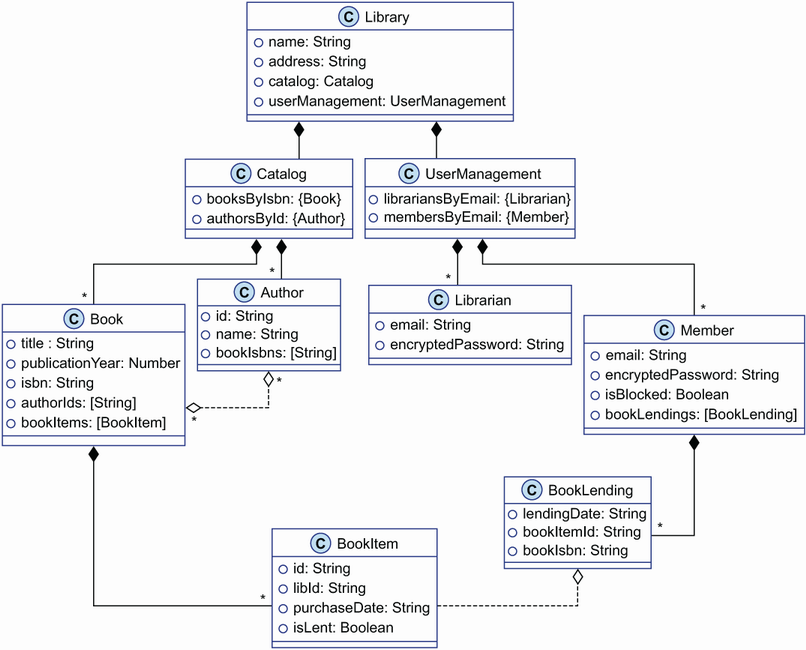
Use the relation model to inspect indirect relations, positional string collections, and indexed entities. section 3.1



