liveBook · Manning

Residual connection

As explained in Graph Neural Networks in Action

A skip connection is a neural-network pathway that passes information around one or more intermediate layers to preserve or combine representations.

A residual connection, or skip connection, creates a pathway around intermediate GNN layers so information can bypass local processing and retain longer-range signals. section 5.5.2

Use residual connections when:

  • Deep message passing causes over-smoothing, making node representations increasingly similar after roughly three or four layers. section 5.5.2
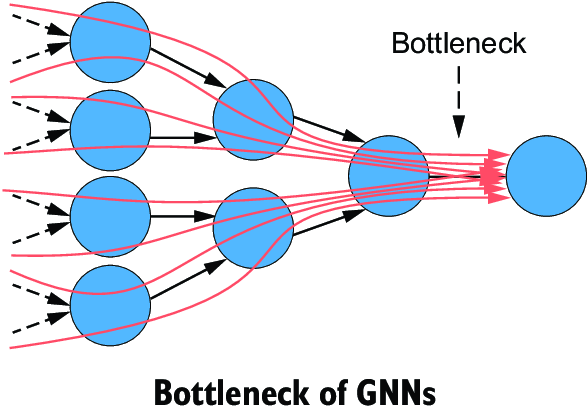
  • Long-range interactions matter but stacking enough layers to match the problem radius would intensify over-squashing. section 5.5.2
  • You need an alternative or complement to attention mechanisms, neighborhood sampling, added edges, or globally connected nodes. section 5.5.2
Figure 5.19 Visualization of over-squashing (Source: Alon and Yahav [7])
figure

Visualize how information becomes compressed across graph distance and why bypass pathways can help preserve distant signals. section 5.5.2

How Graph Neural Networks in Action covers it

How deep it goes
Explains the motivation and trade-off, but stops short of specifying a layer-level implementation.
Examples
Illustrates the need with large molecular graphs, distant atoms, and toxicity-related properties.
What it assumes
Assumes familiarity with graph neural networks, message passing, and the problem radius.
What you can do after
Evaluate/understand when bypass pathways can reduce the need for excessive GNN depth.
How it connects
Connects residual connections to over-smoothing, over-squashing, problem radius, attention mechanisms, and GraphSAGE.

Also explained in

Compare how 12 books explain residual connection →

Related concepts

This explainer was generated by Manning's knowledge graph from the text of Graph Neural Networks in Action. The section links point to the parts of the book it draws on.









