REST organizes an API around requests between a client and a remote service. The client does not need to know how the server computes results, and the server does not retain client state between requests. section 9.3.1
Common REST request types assign different jobs to client-server interactions:
- GET retrieves data, such as search results. section 9.3.1
- POST sends data to a server, such as submitted credentials. section 9.3.1
- PUT replaces or updates server data, while PATCH changes only specified fields. section 9.3.1
- DELETE removes data at a specified server location. section 9.3.1
Serving a customer-churn model
A client sends customer-churn inputs to a remote REST API over HTTPS. Server-side code can fetch features for a customer ID from a database, pass them to the model, and return the prediction. Another language or system can make the request while Python runs the prediction code. section 9.3.1
Figure 9.7 This view modifies Figure 9.6 to show how we can send the customer churn model inputs to a remote server. The model, which lives on the server, will be called to compute the model prediction and return the result to the client.
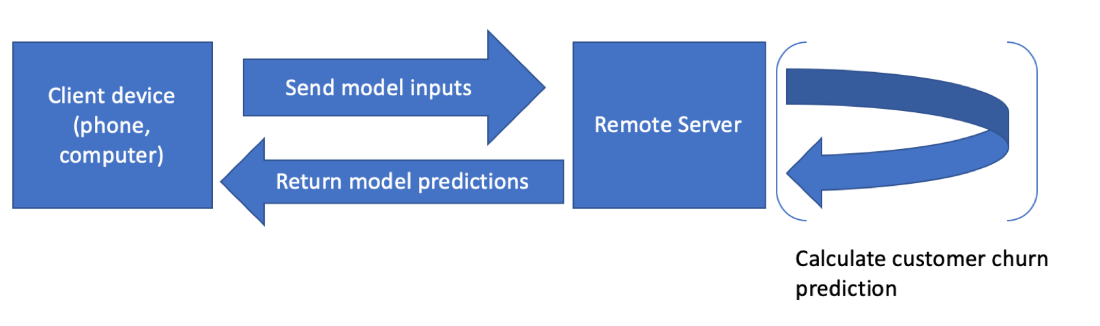
Trace how model inputs travel from a client to a remote server, where the model computes and returns a prediction. section 9.3.1