Investment risk is the possibility that an investment produces an unfavorable outcome, including a loss or lower-than-expected return. Risk and return jointly shape an investment strategy: attractive potential gains do not remove uncertainty, and past results do not guarantee future outcomes. section 1.1 section 1.4
Treat risk as an engineering problem: identify what can fail, estimate its possible effect, prioritize the serious threats, and decide how much exposure fits your goals, time horizon, and tolerance. Price fluctuations may be acceptable; bankruptcy or a system-wide disruption may not be. section 1.5.3 section 7.1.2
Useful risk practices include:
- Classify risks by their possible effect instead of focusing on the easiest detail to understand. A temporary 5% decline can matter less than a portfolio company approaching default. section 7.1.2
- Research what could go wrong in a business, including market disruption, regulation, changing public sentiment, rising costs, ethical concerns, and obsolescence. section 7.1.3 section 4.6
- Use a risk matrix to rank threats by likelihood and severity, then address risks with the greatest potential harm first. section 7.1.3
- Balance speculative holdings with stable investments and consider staged investing so that a loss in a high-risk allocation does not threaten the financial foundation. section 7.4.4
- Use hedging to offset potential losses with an opposing position, accepting that protection can reduce some potential gains. section 1.4
A risk review
Consider a portfolio containing Coca-Cola, Apple, and Pfizer. Review each holding for events that could move its price, map those threats by likelihood and severity, and define an action for the most damaging risks. Apply the same skeptical process to a claim that LiDAR stocks will rebound when interest rates fall: identify why the claim could be wrong before relying on it. section 7.1.3 section 4.3
Figure 7.3 How to map risk in a matrix based on severity and likelihood. We commonly create strategies to meet risks with higher harm severity first to mitigate the effect once the consequences become unavoidable.
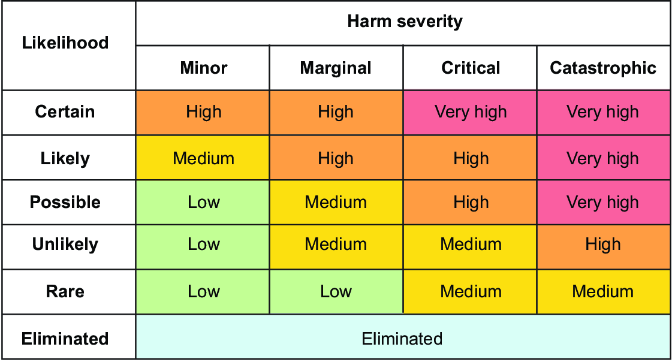
Use the risk matrix to compare threats consistently and prioritize responses according to severity and likelihood. section 7.1.3







