Scalability is the ability of a system or method to handle increasing amounts of data or computation without becoming impractical. In deep learning, small-batch training supports datasets of arbitrary size, while GPU and specialized-hardware parallelization makes larger workloads feasible. The limiting factor is available parallel computing power. section 1.7
Scaling also describes increasing model size, training data, or computation. These choices involve tradeoffs: a fixed budget can fund more data or a larger model, and a smaller model may be preferable when deployment hardware is expensive. More scale generally improves language-model performance, but data availability and computational cost constrain the strategy. section 16.5 section 20.2
Useful distinctions include:
- Data scalability: process larger datasets through repeated small-batch updates rather than requiring the entire dataset at once. section 1.7
- Compute scalability: use parallel hardware and increasing computation to train larger or more capable models. section 16.5 section 1.7
- Practical scalability: balance performance against training cost, inference hardware, and the availability of high-quality data. section 16.5
- Geometric scaling: multiply coordinates by a diagonal matrix to enlarge or shrink an object horizontally or vertically. section 2.3.5
Choosing what to scale
Given a fixed pretraining budget, compare spending compute on a larger model with spending it on more training data. GPT-3 is presented as an example of a model that was too large for its computing budget, making a smaller model trained on more data the potentially better choice. Deployment may likewise favor a smaller model that fits cheaper hardware. section 16.5
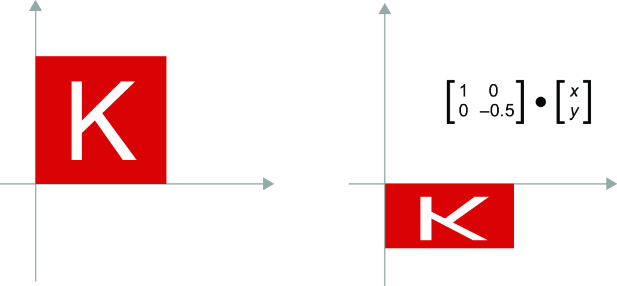
Use the figure to see horizontal and vertical scaling represented as multiplication by a diagonal matrix. section 2.3.5
Figure 16.8 LLM parameter counts and pretraining dataset sizes over time. Many recent proprietary LLMs (e.g., GPT-4, Gemini) are not included because model details have not been disclosed.
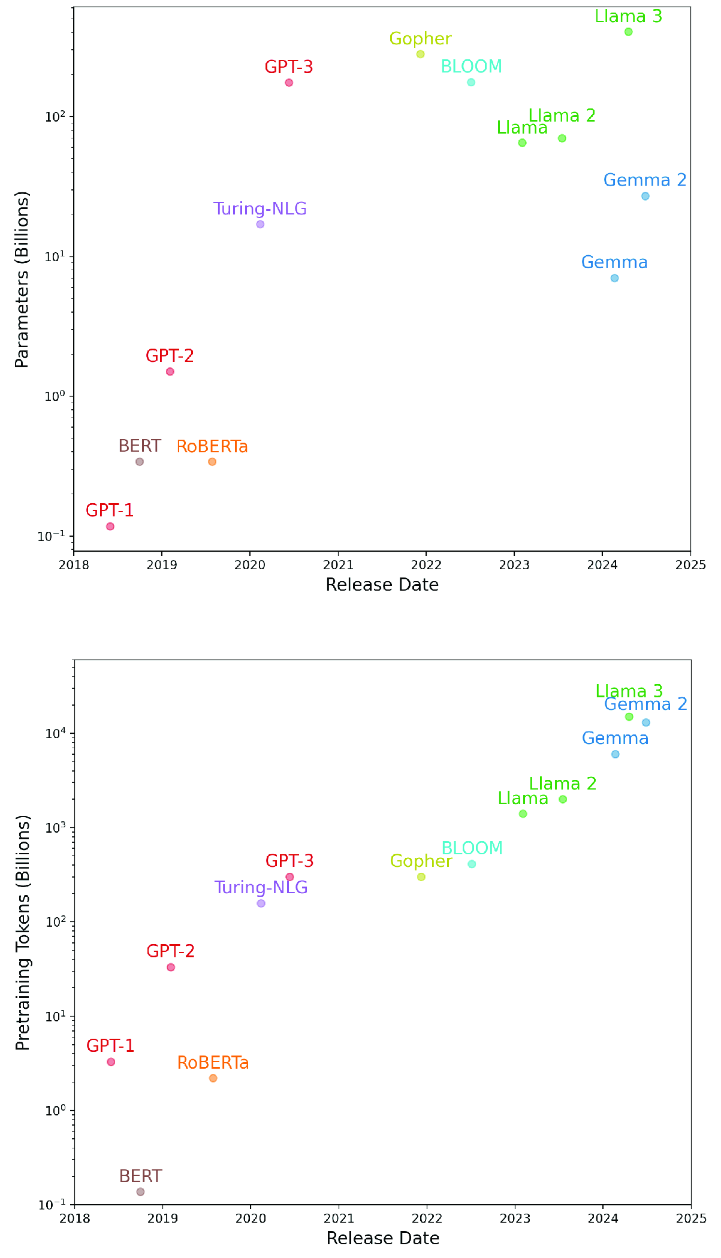
Use the figure to compare LLM parameter counts with pretraining dataset sizes across releases from 2018 to 2025. section 16.5


























