Scalability is the ability of an engineering platform or organization to support increasing teams, clusters, services, and capabilities without sacrificing speed, reliability, cost control, or developer experience. It requires intentional architectural and organizational change, not merely additional servers. section 9.0 section 9.4
A platform that works for a handful of teams can become brittle or expensive at dozens or hundreds. Sustainable growth therefore combines autonomous domain teams, self-service boundaries, event-driven releases, and architectures that reduce centralized bottlenecks and blast radius. section 9.0 section 9.4
Practical scaling patterns include:
- Align platform roles, processes, and domain boundaries with the organization’s changing size and business needs. section 9.0 section 9.4
- Use event-driven releases, contract tests, and notifications to maintain reliability and trust between platform teams and consumers. section 9.0 section 9.4
- Adapt pipelines to cluster count and configuration, and use service lifecycle pipelines to improve release quality. section 9.4
- Move deployment execution toward cluster-level distributed deployers when centralized orchestration creates overhead or excessive blast radius. section 9.4
- Treat platform APIs as the foundation, using adapters, observability integrations, and lightweight management interfaces to connect diverse systems. section 9.4
Scaling a multi-cluster platform
A platform supporting dozens or hundreds of development teams can evolve from centralized orchestration toward domain-owned control-plane teams, dynamic pipelines, cluster-level deployers, contract-tested releases, and event-driven notifications. Cost assessments, including cost of delay, help determine which changes to make first. section 9.0 section 9.4
Figure 9.1 Practical examples of evolutionary scaling strategies for engineering platform components
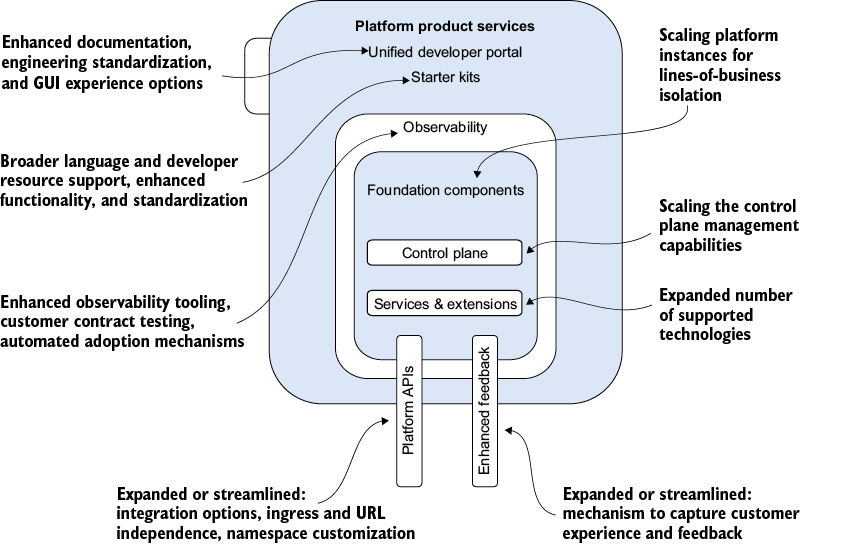
Use the figure to compare evolutionary scaling strategies for platform components. section 9.0


























