Serialization converts application data structures into a standardized sequence of bytes for storage or transmission, allowing another application to reconstruct the data. section 24.1
Figure 24.2 Data serialization formats like JSON allow applications to communicate data in a format understood by both parties.
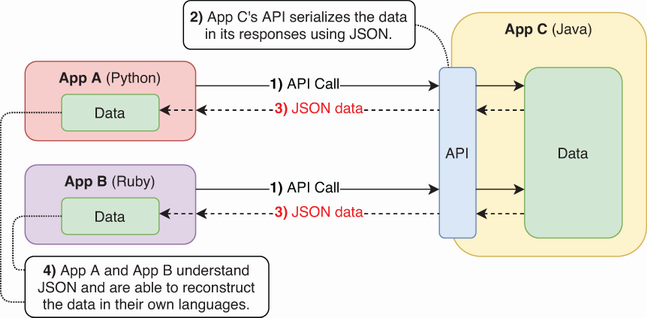
Use the communication flow to see how JSON provides a shared representation between applications implemented in different languages. section 24.1
Common serialization formats include:
- JSON, XML, and YAML provide standardized formats that applications can generate, transmit, store, interpret, and reconstruct. section 24.1
- JSON represents data with primitive values—strings, numbers, Booleans, and null—and structured values such as objects and arrays. section 24.4
- JSON objects contain unordered key-value pairs; keys are strings, values may use any valid JSON type, and trailing commas are invalid. section 24.4
Cross-language API exchange
An API converts App C’s in-memory data structures into JSON. Applications written in other languages can interpret that JSON and reconstruct the data without understanding App C’s internal representation. section 24.1























