Serverless computing runs application functions on managed infrastructure, letting teams focus on application code rather than server provisioning and capacity management. It is one architectural option among monoliths and microservices, not an automatic route to lower cost or better scale. section 5.3.1
Distributed serverless components can introduce coordination, orchestration, and data-transfer overhead. Evaluate them against the workload: independently scaling capabilities and team-owned deployments can favor decomposition, while a computationally intensive, self-contained workflow can favor consolidation into one process. section 5.3.1
Video-quality analysis consolidation
A video-quality analysis service built with AWS Step Functions, Lambda, and S3 reached a scaling limit at 5% of expected load as orchestration and data-transfer costs became unsustainable. Replacing the distributed design with a single process cut infrastructure costs by 90% and improved scaling. section 5.3.1
Figure 5.6 Monolith vs microservices latency
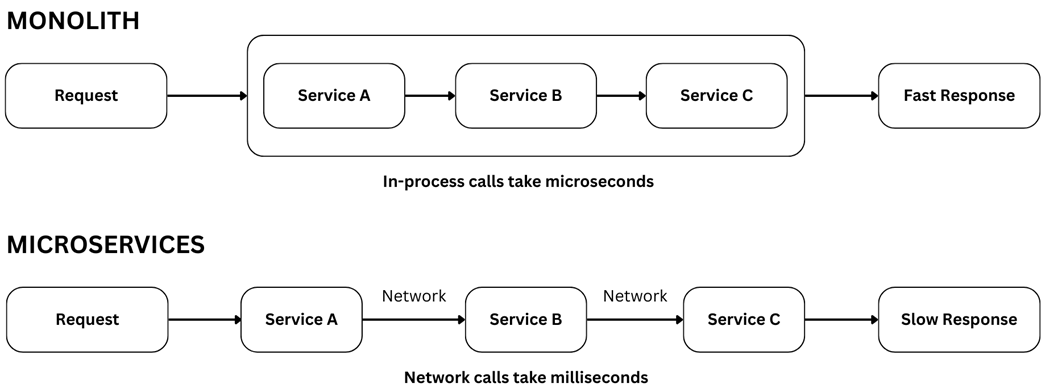
Compare latency implications when weighing a monolith against a distributed, microservices-based design that may include serverless functions. section 5.3.1










