A shared-responsibility model divides security and operational responsibilities between a platform team and the developers who use the platform. The platform team protects the platform and supplies enabling capabilities; developers remain responsible for application security and service-specific operation. section 1.3.3 section 5.2.3
A practical boundary assigns responsibilities by layer:
- Platform teams manage platform security, resiliency, collection infrastructure, data storage, and hosted observability tooling. section 1.3.3 section 5.2.3
- Development teams secure application code and configure dashboards, alerts, and trace publishing for their services. section 1.3.3 section 5.2.3
- The platform can assess code and expose vulnerability capabilities, but it cannot automatically remove vulnerabilities created by developers. section 1.3.3
Epetech observability
Epetech assigns application teams responsibility for service dashboards, meaningful alert thresholds, and trace publication, while the platform team maintains scraping, ingestion, storage, and dashboard hosting. Clear boundaries reduce friction and make monitoring more actionable. section 5.2.3 section 5.5
Figure 5.6 A shared responsibility model is critical to reducing friction when teams adopt any platform service.
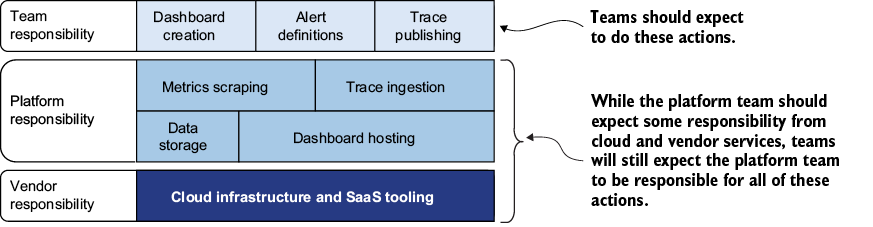
Use the responsibility-model figure to navigate the boundaries that reduce friction when teams adopt a platform service. section 5.2.3





