A shared responsibility model divides Atlas security and operational obligations among customers, MongoDB, and underlying cloud providers. Atlas manages platform security and database operations, while customers manage data access, identities, and selected settings. section 20.1
Apply the model by separating responsibilities across three parties:
- Customers manage data, accounts, roles, identity providers, multifactor authentication, cloud-provider and region selection, infrastructure tiers, connectivity, audit filters, and backup schedules. section 20.1
- MongoDB manages Atlas platform security, database operations, secure data-access tooling, continuous enforcement, authentication, localization, and encryption in transit and at rest. section 20.1
- Cloud providers such as AWS, GCP, and Azure provide physical security and infrastructure. section 20.1 section 20.8
- Treat initial security configuration as shared: customers select and enable settings, then MongoDB continuously enforces essential controls. section 20.1
Atlas security setup
Configure federation, LDAP, or MFA; choose data-residency policies; enable KMS or BYOK encryption; configure network connectivity, auditing filters, and backups. MongoDB then continuously enforces authentication, localization, and encryption controls. section 20.1
Figure 20.1 The shared responsibility model in Atlas divides security and operational tasks among customers, MongoDB, and the underlying cloud providers (AWS, GCP, and Azure). (Image © MongoDB 2024 CC BY-NC-SA 3.0)
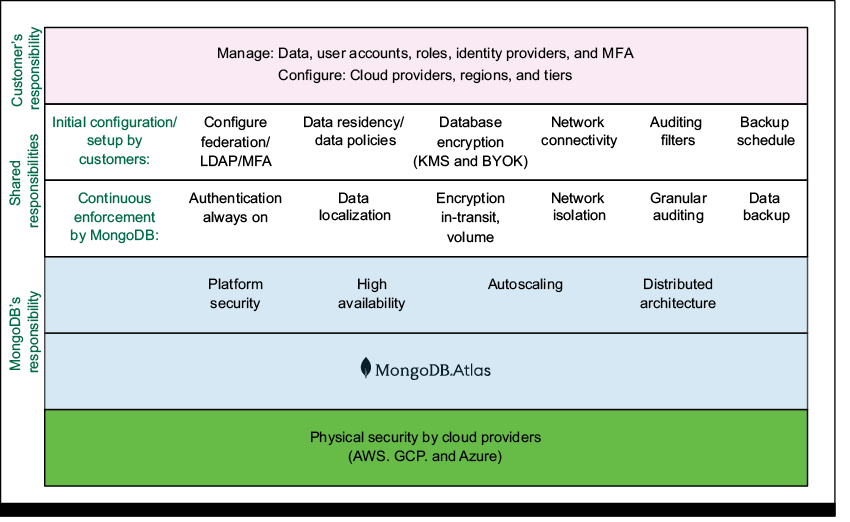
Use the responsibility diagram to locate security and operational duties across the customer, MongoDB, and cloud-infrastructure layers. section 20.1





