liveBook · Manning

Working memory

As explained in The Art of AI Product Development

Agent memory held within the model's current prompt context and available for immediate processing.

Working memory is the information an agent keeps in its current prompt context for immediate processing. It preserves continuity across multistep work, such as carrying trend research into roadmap suggestions, even though language models otherwise reset with each prompt. section 9.2.3

Working memory may contain:

  • Interaction history, including conversations and human-in-the-loop inputs. section 9.2.3
  • Personalization details, completed tasks and outcomes, or retrieved data from RAG sources. section 9.2.3
  • An activity traceback, synthesized summary, or selected relevant thoughts and interactions. section 9.2.3

Roadmap research

An agent researching trends can place its findings in working memory so a later step can synthesize roadmap suggestions. Designers must balance retained usefulness against context size: larger prompts increase latency, token count, and potential inaccuracies. section 9.2.3

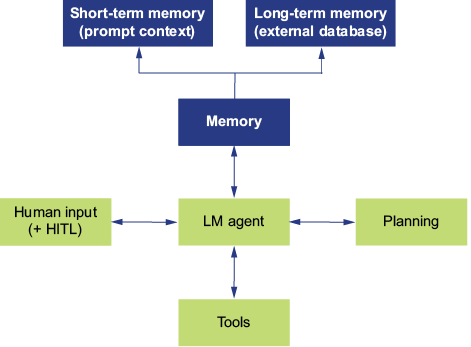
Figure 9.14 Agents need short-term memory for the current session and long-term memory for learning and improvement over time.
A diagram of a computer process

AI-generated content may be incorrect.

Compare working memory for the current session with long-term memory stored externally for later retrieval and improvement. section 9.2.3


How The Art of AI Product Development covers it

How deep it goes
Explains stored content, prompt representations, and context trade-offs, but stops short of implementation details.
Examples
Uses chatbot continuity, trend research, roadmap synthesis, conversations, task outcomes, and retrieved data as examples.
What it assumes
Assumes multistep agent workflows and teaches why stateless language models need prompt-based continuity.
What you can do after
Operate agent workflows by selecting useful context while managing latency, token count, and potential inaccuracies.
How it connects
Connects working memory to prompt context, context windows, long-term memory, RAG databases, and agent systems.

Also explained in

Compare how 7 books explain working memory →

Related concepts

This explainer was generated by Manning's knowledge graph from the text of The Art of AI Product Development. The section links point to the parts of the book it draws on.




