The sigmoid is an S-shaped nonlinear activation function, commonly written as σ. Applied to a weighted sum, it adds nonlinearity so a model can represent classification boundaries that a linear weighted combination cannot. section 1.6
A parameterized sigmoid changes shape through two parameters: w adjusts the steepness of the central portion, while b shifts the curve horizontally. Increasing w makes the curve increasingly step-like, while preserving differentiability. section 8.1.1
Its geometry explains both its usefulness and its training behavior:
- The curve climbs most rapidly through its middle region, where its derivative is largest. section 8.1.1
- The curve saturates toward both ends, becoming nearly flat and producing derivatives close to zero. section 8.1.1
- Unlike the Heaviside step function, the sigmoid is differentiable, making gradient-based neural-network training possible. section 8.1 section 8.1.1
Nonlinear classification
A weighted sum alone produces a linear separator. Passing that weighted sum through a sigmoid bends the model’s response and supports more complex classification tasks, forming a basic neural-network building block. section 1.6
Figure 8.2 Sigmoid curves corresponding to various parameter values in equation 8.2
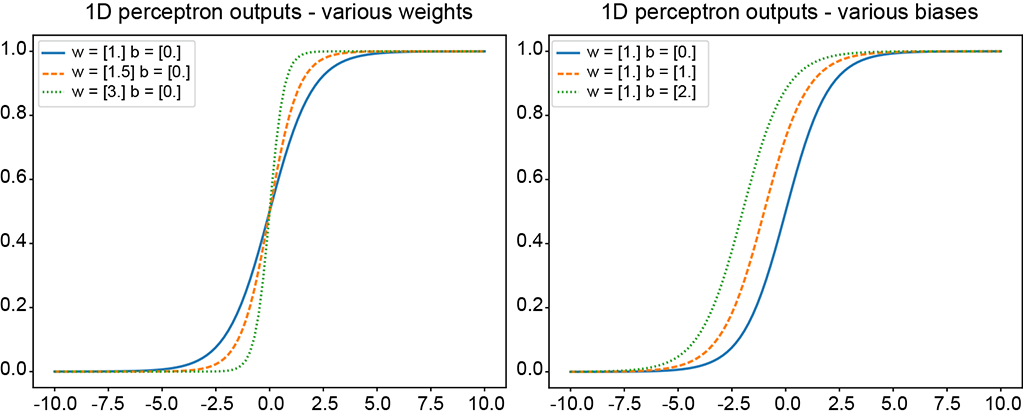
Compare how changing w and b alters the sigmoid’s steepness and horizontal position. section 8.1.1















