Simulation runs a model of a real system to reproduce relevant behavior without operating the physical robot or environment. In robotics, it substitutes a virtual world, robot hardware, sensors, and actuators while allowing substantially the same robot software to run against virtual sensor data and actuator commands. section 5.0 section 5.1
Figure 5.1 A robotics simulator replaces the real world with a virtual environment by providing virtual sensor data to the virtual robot, receiving virtual actuator commands from the robot software, and computing the time evolution of the virtual world according to a physics engine.
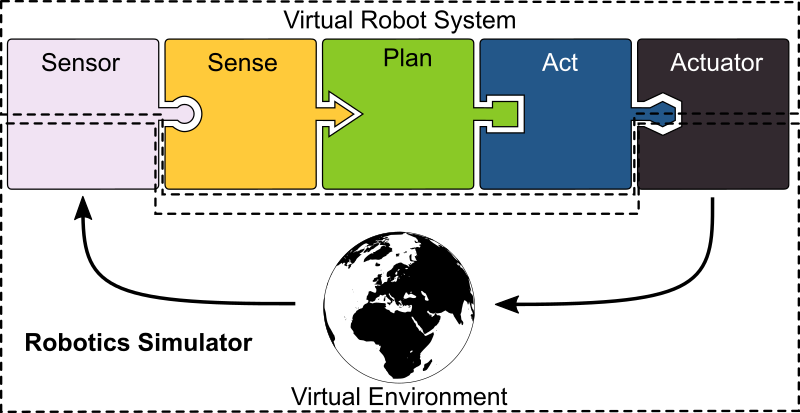
The simulator closes the familiar robot loop: virtual sensors provide observations, software sends actuator commands, and a physics engine advances the virtual world. section 5.1
A practical simulator combines several cooperating models:
- A scene graph tracks robots, objects, and their relationships over time. section 5.1
- Robot and object models define geometry, materials, inertia, friction, joints, links, sensors, and actuators. section 5.1
- A physics engine simulates kinematics and dynamics; rendering, audio, a GUI, and APIs support observation and interaction. section 5.1
Use simulation when learning without hardware, prototyping a robot, or developing hardware and software concurrently. Choose the simplest model that answers the question: kinematics alone can test positions, velocities, and accelerations when forces and torques are not needed. section 5.2
Testing a virtual robot before hardware
A simulated industrial manipulator for 3D printing can check workspace reachability, self-collisions, and estimated print time, even if it cannot accurately predict print quality. Hands-on models also include a cylinder rolling down an inclined plane and a robot made to fall by repeated position commands. section 5.2 section 5.5










