A subnetwork, usually called a subnet, is a smaller logical network created by dividing an IPv4 address block. CIDR prefix lengths mark the boundary between network and host portions, so subnets can use sizes beyond the traditional /8, /16, and /24. section 11.0 section 11.1
Subnetting borrows bits from the original host portion and adds them to the network portion. Each borrowed bit doubles the possible subnets while halving the addresses available in each subnet. section 11.2.1 section 11.5
Identify a subnet through five attributes:
- Network address: the first address, with all host bits set to zero. section 11.5
- Broadcast address: the last address, with all host bits set to one. section 11.5
- First usable address: the network address plus one. section 11.2.1
- Last usable address: the broadcast address minus one. section 11.2.1
- Maximum hosts: 2^y − 2, where y is the number of host bits. section 11.2.2
Borrowing bits from a /24 block
Dividing 192.168.1.0/24 by borrowing one bit creates 192.168.1.0/25 and 192.168.1.128/25. Borrowing two bits creates four /26 subnets: 192.168.1.0, .64, .128, and .192. A 192.168.1.64/26 subnet has network address 192.168.1.64, broadcast address 192.168.1.127, usable range .65–.126, and 62 usable hosts. section 11.2.1
Choosing a subnet size
A LAN requiring 122 hosts needs seven host bits because 2^7 − 2 equals 126; assigning 10.89.100.0/25 provides the required capacity. Smaller LANs can use /26, /27, or /28 subnets according to their host requirements. section 11.3.1 section 11.3.4
FLSM and VLSM
FLSM divides an address block into equal-sized subnets; for example, 172.25.190.0/23 becomes four /25 subnets with 126 usable hosts each. VLSM assigns different sizes: /25, /26, /27, and /28 LANs can share 10.89.100.0/24, leaving a /30 or /31 point-to-point link. section 11.2.4 section 11.3.5
Figure 11.1 The 192.168.1.0/24 address block (network) divided into smaller subnets. With a /24 prefix length, it is one subnet of 256 addresses. Using a /25 prefix length allows the block to be divided into two subnets of 128 addresses each. /26 allows for 4 subnets of 64 addresses each. /27 allows for 8 subnets of 32 addresses each. /28 allows for 16 subnets of 16 addresses each.
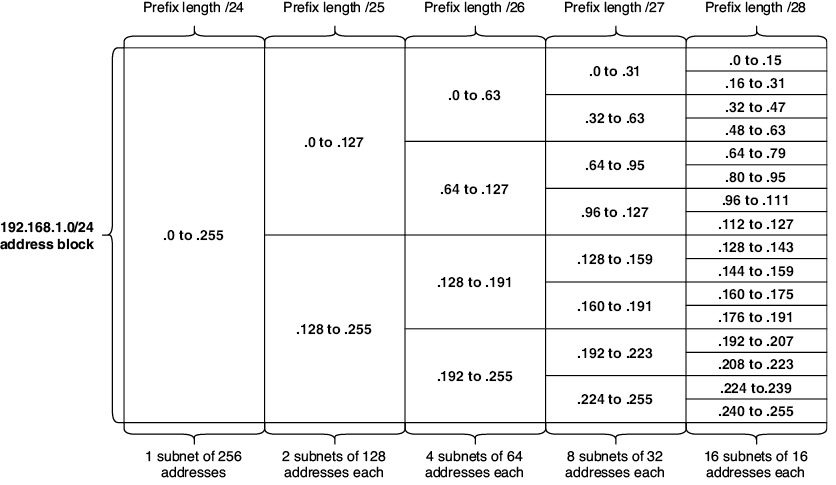
Compare how increasing a /24 prefix from /24 through /28 multiplies subnet count while reducing addresses per subnet. section 11.1
Subnets also provide Layer 3 segmentation. Hosts in different subnets must send traffic through a router, where policies can control communication between departments or other network groups. section 12.1.1




