A summarization engine condenses source content without a conversation. It can return a summary immediately or store it for another application. When large volumes of text make manual summarization impractical, the engine can serve multiple systems through a REST API. section 1.1.1 section 3.0
A research summarization engine extends that job from supplied text to web research. Given a question, it searches for sources, extracts page content, summarizes each page, and combines the findings into a report. Unlike a summarization chatbot, it does not rely on dialogue to refine the result. section 4.1 section 1.1.2
Build the research workflow as separate operations:
- Turn a broad question into targeted search queries, then submit them through a web search API. section 4.8
- Fetch the returned pages, extract content with HTML parsing, and ask the LLM for key facts and arguments from each page. section 4.8
- Combine the partial summaries into a coherent report with citations. Handle errors in search, extraction, and LLM calls independently. section 4.8
A sequential pipeline makes each component easier to inspect before optimization. In LangChain Expression Language (LCEL), the pipe operator connects steps so one output becomes the next input. RunnableParallel can run operations on the same input concurrently, while `.map()` processes multiple URLs or search results in parallel. section 4.6 section 4.8
Figure 4.2 Automated research summarization engine. Ask a question, and the engine performs a web search, returns URLs, scrapes and summarizes web pages, and compiles a research report for you.
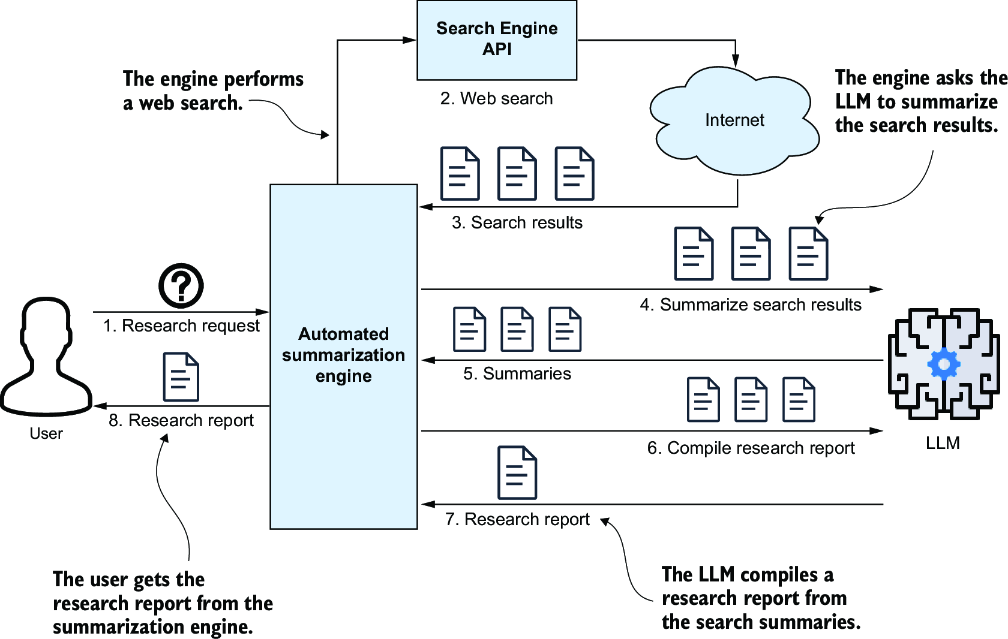
Follow the question through search, page scraping, individual summaries, and the final research report. section 4.1
