Synthetic data is artificially generated data designed to resemble selected characteristics or distributions of real data. It helps address scarce or noisy datasets by expanding training data, improving quality, and reducing overfitting risk. section 10.2 section 9.3
Common generation patterns include:
- GANs transform random noise through learned layers until the output resembles the target data distribution. section 10.4.1
- Adversarial training has a generator produce synthetic examples while a discriminator evaluates whether inputs are real or synthetic. section 10.4.3 section 10.4.2
- Autoencoders compress data into a lower-dimensional code and reconstruct it, supporting generation of data like the original dataset. section 9.3
Healthcare dataset augmentation
When a healthcare dataset is too small for reliable model training, generated examples can augment the available data. GAN training improves realism iteratively: the generator creates candidates, the discriminator scores them, and both networks update from their losses. section 10.2 section 10.4.3
Figure 10.1 Representation of a GAN
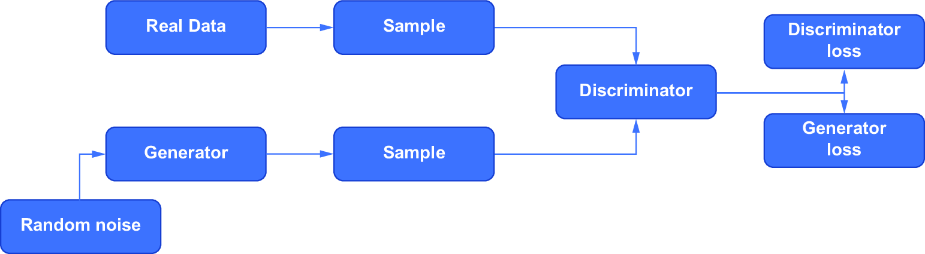
Use the GAN diagram to trace how random noise becomes synthetic data and how the discriminator feeds quality signals back into training. section 10.4.1














