Generative search creates new responses from a query or prompt instead of returning only existing documents, extracted answers, or fixed information boxes. A generative model can produce text, images, audio, or video according to patterns learned from training data. section 15.2
The search pipeline shifts from finding and ranking matching content toward dynamically analyzing results and synthesizing a response. Common applications include abstractive question answering and results summarization, while emerging systems combine multiple data sources and modalities as context. section 15.2 section 15.6
Personalized itinerary generation
A user could ask for an optimal three-day Paris agenda while specifying preferences for fine dining, historic buildings, museums, and avoiding crowds. The system would generate a tailored response rather than return a conventional list of links. section 15.2
Generative search changes both the output and the responsibilities of a search system:
- It can synthesize information instead of asking users to interpret separate documents. section 15.2
- It can introduce political or commercial bias, censorship, propaganda, misinformation, or dangerous generated content. section 15.2
- It can converge with vector databases, multimodal retrieval, recommendations, chatbots, and question-answering systems. section 15.6
Figure 15.2 Spectrum of traditional search approaches (left) to generative search (right)
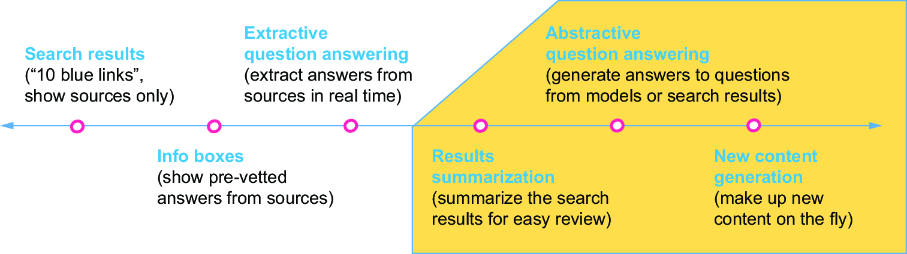
Use the spectrum to compare traditional links and fixed answer boxes with responses generated dynamically from search results. section 15.2



















